From biomed shops to ER networks, organizations are building sustainability gains into how they repair, purchase, and operate.
By Alyx Arnett
For years, when a circuit board failed in a piece of medical equipment at ReNew Biomedical, the board was sent out for recycling. The company didn’t have the capability to diagnose component-level failures, making replacement the only practical option.
That changed this year. After investing in new diagnostic equipment and training, ReNew launched an in-house board repair program to recover boards that previously would have been discarded. Before the program was even in place, the company began setting failed boards aside instead of recycling them, creating a backlog that technicians could eventually repair.
“ReNew’s motto has always been, ‘We save the lives of lifesaving equipment.’ Now, with board repair, we’re able to take it to the next level,” says Lukas Brooks, CBET, biomedical technician at ReNew Biomedical.
ReNew isn’t the only organization working to reduce waste. Across healthcare, organizations are finding new ways to reduce waste, extend the life of medical equipment, and lower costs through repair, strategic purchasing, and operational improvements.
Keeping Circuit Boards in Service
ReNew Biomedical launched its board repair program in February 2026 after investing in diagnostic equipment and training from ABI Electronics, a company that develops tools for troubleshooting and repairing printed circuit boards. The goal was to stop recycling viable boards and begin recovering components from devices that were often obsolete or no longer supported by original equipment manufacturers (OEMs).
Today, Brooks leads ReNew’s board repair program, a role he took on after completing a week of specialized training from ABI Electronics. He says the work requires a different mindset than traditional healthcare technology management (HTM).
“Generally, you think HTM is, ‘OK, a part has gone bad. Let me change that part out,'” Brooks says. “But the board repair is more like electrical theory and electronics, so you have to delve deeper into it.”
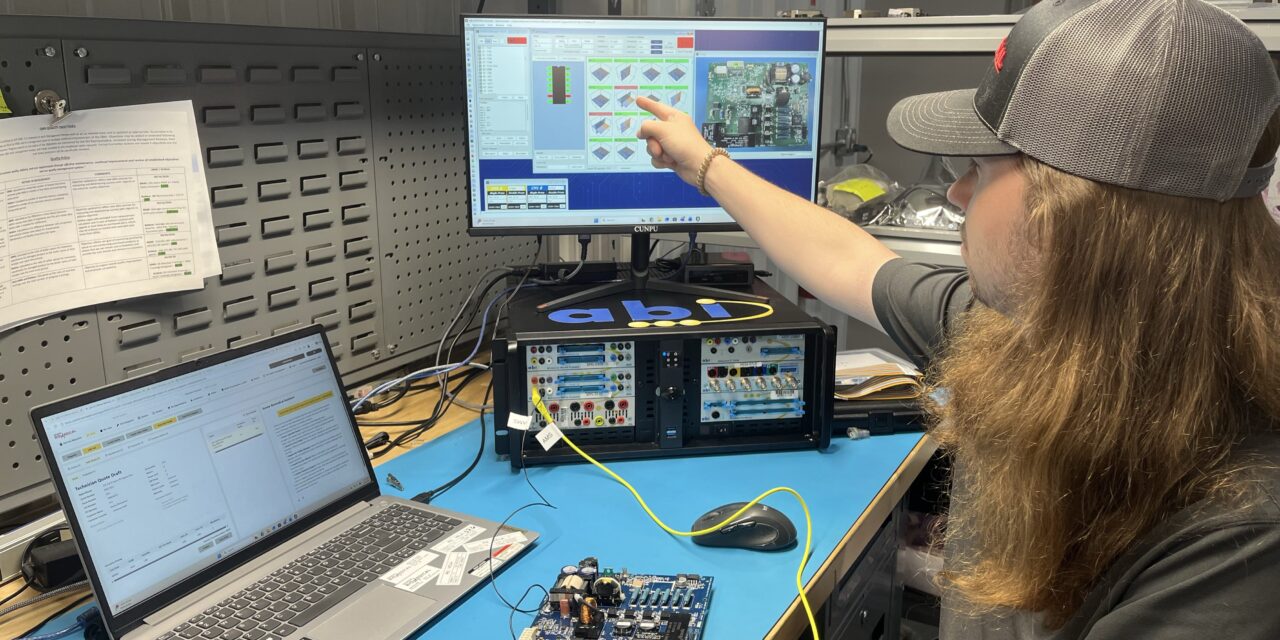
Using the specialized diagnostic equipment, Brooks identifies component-level failures that allow circuit boards to be repaired rather than replaced. That approach has proven particularly useful for extending the life of older defibrillators used by EMS agencies, hospitals, and fire departments that can’t easily replace aging equipment, he says. Brooks points to the Zoll R Series PD engine—the board responsible for delivering the shock—as one of the program’s most common repairs.
Since February, Brooks says he has repaired 83 circuit boards that otherwise would have been recycled. Because many of the devices are no longer manufactured, repairing those boards helps keep the equipment itself in service.
“Since these units are not supported by the OEMs anymore, there’s only so many boards that we have,” Brooks says. “A lot of EMS, hospitals, [and] fire departments, especially here in a rural area, don’t have the large budget to buy new devices. So being able to extend the lifespan of the devices they currently have just extends their lifesaving capabilities.”
Challenging the Make-Break-Replace Cycle
The diagnostic tools used by ReNew Biomedical are part of a larger push by ABI Electronics to change how industries handle electronic waste. Willian Santos, international sales manager at ABI Electronics, notes that global electronic waste is approaching 60 million tons annually, with industrial and commercial equipment accounting for roughly 30% of that total.
Santos says recycling should be a last resort rather than the default response to a failed circuit board. He points out that even with modern technology, only about 15% of the raw materials built into a printed circuit board can actually be recovered during the recycling process. Instead, he advocates for a repair-first approach, urging organizations to develop the in-house capability to maintain critical assets.
“If you go from buying a new asset, putting it in operation, and the moment that something happens—it could be a simple component failed or a fuse that is blown—you just throw it away and buy it new … you’re not learning anything,” Santos says. “If anything, you are losing capability or diminishing capability, and you just look at that make, break, replace as kind of a circle.”
If repairing boards can extend equipment life and reduce waste, why isn’t it more common? Santos says several factors have pushed healthcare toward replacement instead. He estimates that more than 90% of medical electronics are replaced rather than repaired, citing a combination of risk aversion, OEM service agreements that discourage component-level repair, and a shortage of technicians with the specialized training needed to diagnose electronic failures.
Santos argues that those barriers are becoming easier to overcome as diagnostic, troubleshooting, and reverse engineering technologies continue to advance, making component-level repair more accessible even when OEM documentation is unavailable. But he says technology alone isn’t enough.
Education, he says, remains critical. While engineering programs continue to teach students how to design electronics, he believes far less emphasis is placed on diagnosing and repairing them.
“We train groups on how to design stuff, but not how to fix the stuff anymore,” he says.
Beyond training individual technicians, Santos believes healthcare organizations should also build the in-house capability to evaluate whether equipment truly needs to be replaced. “You should have enough know-how … to make the decision of how long that asset is going to remain in operation—not the OEM,” he says.
Inside Stony Brook University Hospital’s Sustainability Strategy
Stony Brook University Hospital in New York, a Practice Greenhealth Top 25 Hospital recognized for environmental excellence, has spent more than a decade building sustainability into hospital operations. Under the leadership of Carol Gomes, chief operating officer and CEO, a sustainability steering committee helps departments evaluate the environmental impact of purchasing, equipment, and operational decisions.
Every new product under consideration at Stony Brook is evaluated for both clinical needs and environmental impact. The committee considers whether more sustainable alternatives are available and whether products can be safely reprocessed or use safer chemicals.
Gomes says that process has influenced major capital purchases across the 628-bed academic medical center. As one example, when the anatomic pathology laboratory needed new tissue processors—equipment that traditionally relies on chemicals such as xylene and formaldehyde—the hospital chose models designed to reduce chemical use. According to Gomes, the new tissue processors reduced xylene use by at least 10%.
Beyond procurement, Stony Brook has also focused on reducing medical device waste through reprocessing. The hospital works with vendors to disinfect and reuse eligible devices in accordance with manufacturer guidelines. Gomes says pulse oximeter sensors, EP catheters, manifolds, and ultrasonic scalpels are among the items now reprocessed, with 18% of collected devices successfully reused.
The hospital has also found other opportunities to reduce waste. After studying how operating room kits were being used, Stony Brook found that many peel packs were opened before surgeons determined whether every item inside would be needed. Today, staff keep the packs sealed until they are actually required, reducing unnecessary waste while also cutting the water and energy needed to reprocess unused items, Gomes says.
For capital equipment, the biomedical engineering team plays a direct role in preventing premature replacement. Each year, the department generates a list of equipment that has reached the manufacturer’s designated end of life, but Gomes says that designation is only the starting point for replacement discussions.
“Just because something is at end of life doesn’t mean it should be replaced,” Gomes says. “We look at service, how often the item is serviced, whether or not the vendor will serve it any longer, and if there are not any parts available. If there’s an end-of-life piece of equipment, it’s still functioning optimally and we still can service it, we will not replace it.”
Tracking Data to Uncover Hidden Waste
Sometimes the biggest sustainability gains come from analyzing operational data organizations don’t realize they already have. When ProCare ER, a network of emergency rooms in Texas, partnered with business analytics firm Minus 2 Degrees (M2D) for a pilot program, the goal was to establish a baseline of the organization’s environmental impact using existing operational data. The analysis identified where the emergency rooms were generating the most emissions and where operational changes could have the greatest impact.
Sadaf Shah, operations director at M2D, says many healthcare organizations already have the information needed to make sustainability decisions; they just may not realize it. Utility bills can provide insight into energy use, while purchasing records can reveal inventory patterns and procurement practices.
“You don’t need to go physically take the measurement. All you have to do is take all their last 12 months’ bills. That’s going to give you a really good insight of how much energy they have used,” Shah says.
For ProCare ER, those records uncovered several opportunities for improvement. By analyzing invoices, the team identified how much inventory each facility was buying, how much was actually being used, and where surplus inventory was accumulating. Additionally, the analysis prompted changes to how supplies were delivered. ProCare ER switched to a medical oxygen supplier that delivers cylinders using electric vehicles and consolidated deliveries by expanding on-site storage. Instead of receiving four oxygen deliveries each month, the emergency rooms now receive one monthly shipment, reducing transportation-related emissions.
Utility and operational data revealed a different set of issues. At one facility, emissions were significantly higher than at comparable sites. The team traced the problem to a leaking HVAC system that was using approximately four times more gas than HVAC systems at other facilities. Fixing the leak brought the facility’s emissions back in line with the rest of the network.
Additional changes included separating waste streams, converting facilities to LED lighting, and implementing more efficient lighting and thermostat schedules. David Ortiz, marketing director at ProCare ER, says those operational changes produced measurable financial benefits alongside the environmental improvements.
“Across our ERs, the combined electricity cost savings were significant, and one of our facilities alone saved the equivalent of roughly six months of electricity bills,” says Ortiz. “There’s a misconception that sustainability automatically means high cost. But once you understand it properly, it’s actually quite simple. And the return far outweighs the complexity.”
Looking back on the pilot, Ortiz says the biggest takeaway was gaining a clearer picture of the organization’s environmental impact.
“We go through our daily routines, tossing things out, getting rid of boxes and papers, without ever thinking about where it adds up … We were genuinely surprised by the scale of [waste], daily and weekly,” he says.
A Lifecycle Approach to Sustainability
Manufacturers are also rethinking how medical equipment is designed, maintained, and supported. Kelvin Sanborn, global head of sustainability at GE HealthCare, says sustainability is increasingly being incorporated into product design through a lifecycle approach that emphasizes maintaining, upgrading, refurbishing, and supporting equipment over longer periods rather than viewing devices as products that are eventually replaced. Manufacturers are also investing in capabilities such as predictive maintenance and remote service to support equipment performance while reducing resource use, he says.
Those changes, Sanborn says, should also influence how healthcare organizations evaluate new equipment purchases.
“HTM and clinical engineering teams should evaluate sustainability through a lifecycle lens, not just upfront cost,” Sanborn says.
Looking beyond the purchase price means considering factors such as expected service life, maintenance requirements, energy and resource consumption, upgradeability, repairability, and whether a manufacturer offers predictive maintenance or structured lifecycle extension programs. Increasingly, manufacturers are also providing sustainability and lifecycle data to help healthcare organizations make more informed long-term investment decisions.
Still, Sanborn cautions that extending equipment life is not always the most sustainable option.
“Extending equipment life is often a powerful lever for sustainability, but it is not always the most sustainable option in every situation,” he says. “The key is to evaluate each asset through a lifecycle lens that considers clinical performance, reliability, serviceability, resource requirements, and long-term value.”
Ultimately, Sanborn believes sustainability and operational performance are becoming increasingly intertwined. As healthcare organizations place greater emphasis on lifecycle planning, he says HTM professionals will play a growing role in helping determine when equipment should be maintained, upgraded, refurbished, or replaced.
“Sustainability is becoming more integrated into core business and operational planning,” Sanborn says. “As a result, HTM professionals will play a growing role in helping organizations align technology decisions with objectives related to operational performance, supporting efforts to deliver care more efficiently, manage constrained resources more effectively, and strengthen long-term system resilience.”
Photo caption: Cameron Cox, a biomedical technician at ReNew Biomedical, uses component-level diagnostic software to identify faults on a circuit board as part of the company’s in-house board repair program.
Photo credit: ReNew Biomedical