
A seven-facility initiative suggests US healthcare facilities could save $187 million annually through operational changes.
A pilot program across seven emergency care facilities in Texas reduced operational waste and lowered carbon emissions, resulting in more than $30,000 in annual cost savings per facility, according to a report from Minus 2 Degrees, a business analytics and carbon reduction partner.
The initiative led to a total reduction of more than 900 tons of carbon dioxide equivalent. Average emissions decreased by approximately 130 tons of carbon dioxide equivalent per facility, with some locations reporting reductions of more than 60%, according to Minus 2 Degrees.
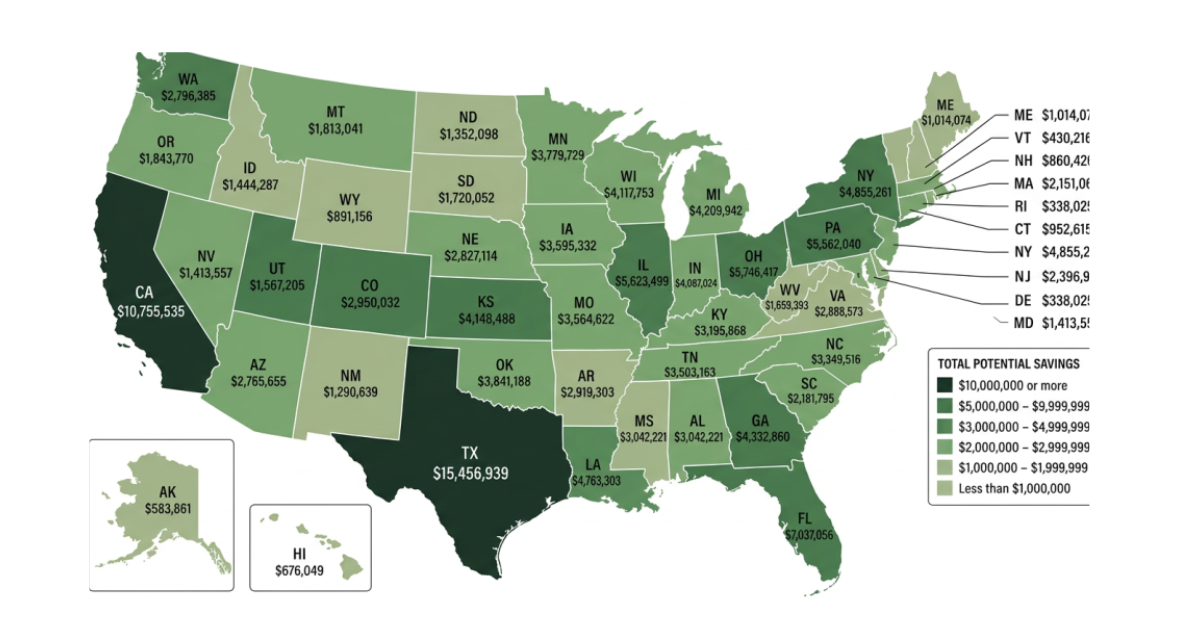
The findings suggest that if similar measures were adopted across comparable healthcare facilities nationwide, the US healthcare sector could save more than $187 million annually and reduce emissions by approximately 793,000 tons of carbon dioxide equivalent each year.
“This pilot program shows that practical operational changes can deliver measurable impact, which, when rolled out at scale, could be incredible for communities and business across the US,” says Sadaf Shah, operations director at Minus 2 Degrees, in a release.
National Impact and State Savings
According to the report, Texas ($15.4 million), California ($10.7 million), and Florida ($7.0 million) represent the states with the highest potential annual savings. Data from the Centers for Medicare and Medicaid Services indicates US healthcare spending reached $5.3 trillion in 2024, representing nearly 18% of GDP. Research published in Nature Climate Change estimates the US healthcare sector contributes approximately 8.5% of national greenhouse gas emissions.
Participating facilities reported significant decreases in carbon dioxide equivalent between their baseline reporting and the 2024-2026 period:
- ER Now (Wichita Falls): 348 to 153 metric tons of carbon dioxide equivalent (tCO₂e)
- Fairfield Emergency Room (Cypress): 148 to 120 tCO₂e
- Emergency Care of Floresville (Floresville): 240 to 112 tCO₂e
- Excel ER (Nacogdoches): 178 to 91 tCO₂e
- Excel ER (Odessa): 276 to 120 tCO₂e
- Schertz Cibolo Emergency Clinic (Schertz): 429 to 126 tCO₂e
- Texas Emergency Care Center (Pearland): 79 to 67 tCO₂e
Examples of changes from one of the participating health facilities included:
- Energy Updates: 65,530 kWh saved over two years, cutting electricity costs by $8,553 (≈ eight months of bills) through efficient upgrades, optimized HVAC, and employee power-downs.
- Medical Supplies Procurement: 85%+ CO2 reduction in 2025, saving ≈ $12,000 via streamlined ordering and supplier optimizations and improved procurement structure.
- Amazon Purchases: 82% CO2 reduction via consolidated shipments and eco-friendly products, saving ≈ $4,000.
- Waste Reduction: Improved segregation and recycling delivered ≈ $600 in operational savings.
- Home Office: Remote work and low-power setups cut CO2 nearly 69%, saving ≈ $1,300 in energy costs.
Operational Efficiency and Sustainability
The program focused on practical changes to improve business performance while meeting sustainability expectations. Finance and operations leaders at the participating sites noted that the changes impacted overhead costs and facility efficiency.
“Partnering with Minus 2 Degrees has made sustainability part of how we operate every day,” says Marcos Sanchez, facility administrator at Excel ER Odessa, in a release. “Their insights not only reduced our carbon footprint but also improved our facility’s efficiency and lowered overhead costs.”
Laura Russo, director of finance at ProCare Health, noted that the operational efficiencies identified helped reduce both the carbon footprint and overhead costs. “It showed us that sustainability is not just good for the environment, it is also smart business,” says Russo, in a release.
Stephanie Ruiz, facility administrator at Schertz Cibolo Emergency Clinic, noted the value of the analysis provided during the pilot. “Minus 2 Degrees gave our company a comprehensive analysis of how we can be proactive in decreasing our daily carbon footprint to help the environment,” says Ruiz, in a release.
Minus 2 Degrees calculated these reductions by comparing baseline reporting with operational data from 2024 to 2026. The organization provides tools for emissions monitoring and decarbonization strategies for various healthcare institutions, including hospitals, urgent care centers, and outpatient clinics.
Photo caption: Potential savings by state, per Minus 2 Degrees
Photo credit: Minus 2 Degrees