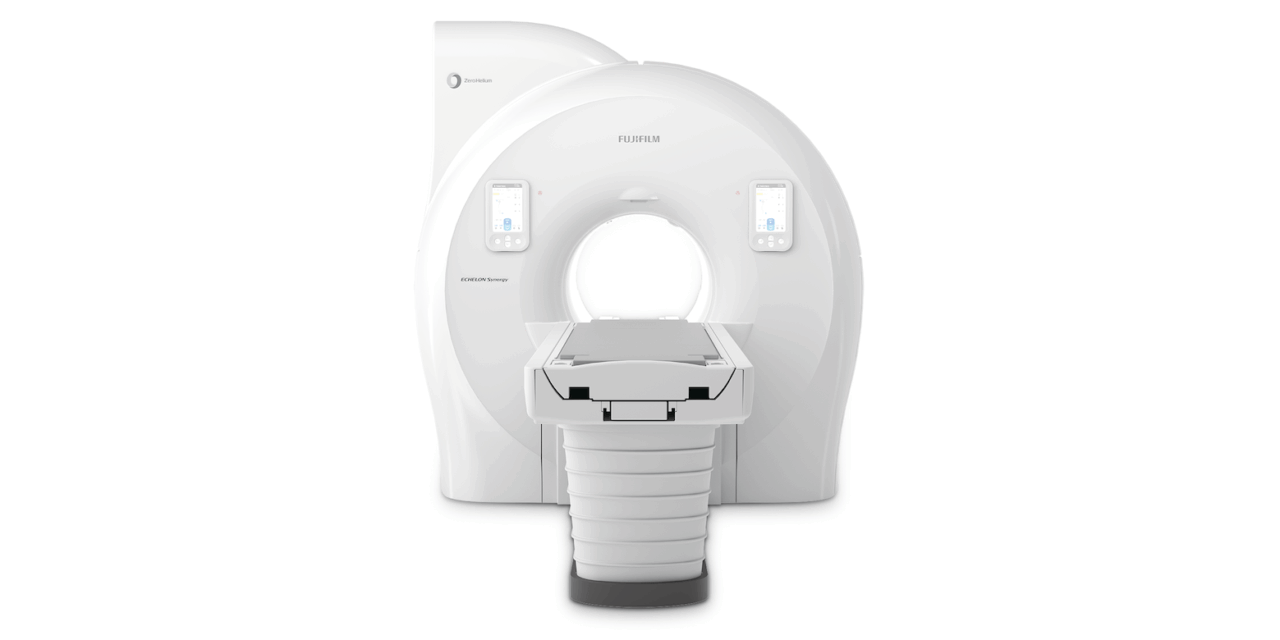
The version 11 platform lets providers choose a ZeroHelium or conventional magnet, with or without a dockable patient table.
Fujifilm Healthcare Americas Corp has introduced version 11 of its Echelon Synergy 1.5T MRI platform, adding a ZeroHelium magnet option designed to operate without liquid helium. The company will showcase the updated system for the first time in the US at the Radiological Society of North America annual meeting, Nov 29 to Dec 2.
With the version 11 upgrades, healthcare organizations can configure Echelon Synergy to their clinical, operational, and facility needs, according to the company. Options include a ZeroHelium or conventional magnet, with or without the SynergyGlide dockable patient table. SynergyGlide is a power-assisted table that allows patient preparation and transport outside the exam room. Fujifilm says it is intended to streamline workflow, patient handling, and comfort.
“Healthcare providers are looking for MRI technology that can address not only clinical performance, but the operational realities of running a modern imaging department,” says Henry (Hidetoshi) Izawa, president and CEO and global head of medical informatics at Fujifilm Healthcare Americas Corp, in a release. “ZeroHelium adds an important new option by helping reduce infrastructure requirements, while the platform’s advanced imaging and automation technologies are designed to help technologists work efficiently and deliver a positive patient experience.”
Cooling Without Liquid Helium
Superconducting MRI systems have historically used liquid helium to cool their magnet coils and maintain superconductivity. Fujifilm’s ZeroHelium technology uses a dedicated cooling system to maintain superconductivity at approximately -269°C without liquid helium. The company says this can help reduce risks associated with helium loss during unexpected events or power interruptions and provide more predictable operating costs.
The magnet is engineered to control thermal effects and suppress vibration, helping maintain consistent image quality. When an emergency ramp-down is not required, in-house staff can ramp down and restart the magnet in a couple of hours instead of days, without a liquid helium refill. Fujifilm says this can simplify recovery and reduce potential downtime.
Imaging and Workflow Features
Version 11 includes several imaging and automation tools:
- Image quality: Deep Learning Reconstruction is designed to reduce noise and enhance image clarity, and can be applied to all body regions and a wide range of sequences. IP-RAPID is designed to help shorten scan times, and DLR Plus is designed to further refine image quality.
- Automation: AutoExam, AutoPose, and Auto Series are designed to reduce repetitive manual steps in exam setup and scanning. In the US, AutoExam is available for knee exams only, and AutoPose is available for anatomical regions other than the brain.
- Motion monitoring: Synergy Vision uses cameras at the front and rear of the bore to help operators monitor patient movement, including coughing or sneezing that may contribute to artifacts. Separate post-processing capabilities are designed to help reduce motion artifacts and potential repeat scans.
Design and Operations
Echelon Synergy has a 70 cm wide bore and a patient table designed for flexible positioning across a variety of patient sizes and exams. Its coil portfolio includes FlexFit Neuro and flexible blanket coils.
On the operations side, the ZeroHelium configuration includes Smart Eco Plus functionality, which is designed to reduce energy consumption during idle periods. Fujifilm’s remote monitoring and predictive diagnostics are intended to help identify potential issues early and support proactive maintenance planning.
The Echelon Synergy ZeroHelium MRI system with the SynergyGlide table received a 2026 Red Dot Product Design Award. Echelon Synergy ZeroHelium and Echelon Synergy version 11 are available for sale in the US.