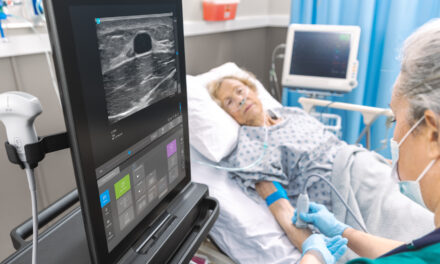

The portable system scans the brain for embolic signals in 40 seconds without requiring specialized ultrasound skills.
Burl Concepts has received US Food and Drug Administration (FDA) 510(k) clearance for its Foqus ultrasound system, a device indicated for measuring the occurrence of transient embolic signals in the brain blood stream. The San Diego-based private medtech company develops tests for evaluating cerebral blood flow and rapidly detecting emboli.
Foqus is powered by the company’s Sonas technology. The system scans the whole brain for emboli in 40 seconds to help physicians identify an existing right-to-left shunt, such as a patent foramen ovale (PFO). A single nurse can perform the test in physician offices, diagnostic centers, or hospitals.
“Identifying a PFO in a patient who has had a cryptogenic stroke is a critical step toward preventing the next one,” says Matthew J. Price, MD, professor of medicine and director of the cardiac catheterization laboratory at Scripps Clinic in La Jolla, in a release. “Foqus gives us a simple, objective test that evaluates the whole brain without the need to find a specific acoustic window or vessel.”
How the System Works
Foqus is a portable, automated transcranial ultrasound system that monitors the entire brain for the appearance of emboli. The first clinical application will be a standard PFO bubble test. In that test, an air bubble solution is administered intravenously, and acoustic signals generated by the bubbles are detected as they pass through the brain’s circulation. Detecting such a signal helps physicians identify a right-to-left shunt. This is commonly caused by a PFO, a hole between the left and right atria of the heart that failed to close after birth.
According to the company, traditional transcranial Doppler requires a skilled operator to locate the temporal bone window and identify a specific vessel segment. Foqus instead uses low-energy, low-frequency ultrasound to penetrate the skull and evaluate the whole brain, detecting acoustic signals from the entire circulation, including both macro and microvasculature.
The test is fully automated and delivers objective, quantitative data, according to Burl Concepts. It provides an immediate results display and a detailed report indicating whether embolic signals were detected. Because the system does not require a cardiologist or anesthesiologist, the company says PFO testing can be performed in any location.
“Foqus makes screening quick and accessible: a test of about five minutes that can be performed in virtually any location, without specialized ultrasound skills,” says Thilo Hoelscher, MD, chief medical officer of Burl Concepts, in a release. “For the first time, a PFO screening test can be broadly available, helping to identify patients earlier and reduce the risk of disabling strokes.”
Clinical Context and Launch Plans
Approximately 40% to 50% of patients with cryptogenic stroke have a PFO, according to research cited by Burl Concepts.
The clearance follows the CE Mark for Sonas stroke detection and first human uses of the technology in the Netherlands and the United Kingdom. Foqus is currently being used in both countries, where early experience has included the detection of embolic signals associated with right-to-left shunting. Additional clinical trials in the US and Europe are underway.
Burl Concepts is preparing for its initial US commercial launch in early 2027, with a focus on cardiology practices and outpatient diagnostic centers.
“Our goal is not simply to make testing faster; it is to remove practical barriers that limit where and how efficiently patients can be evaluated,” says Peter van der Sluis, CEO of Burl Concepts, in a release. “Similar to the expansion of cardiac arrhythmia monitoring into outpatient settings, we believe Foqus has the potential to broaden access to transcranial testing.”
Photo caption: The Foqus ultrasound system, powered by Sonas, scans the brain for emboli in 40 seconds to help physicians identify an existing right-to-left shunt, such as a patent foramen ovale. The test can be performed by a nurse in physician offices, diagnostic centers, or hospitals.
Photo caption: Burl Concepts