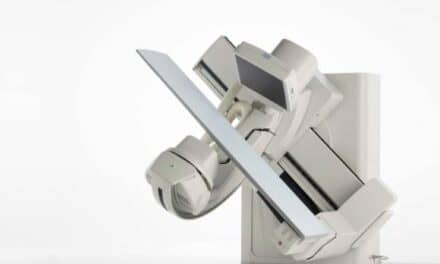
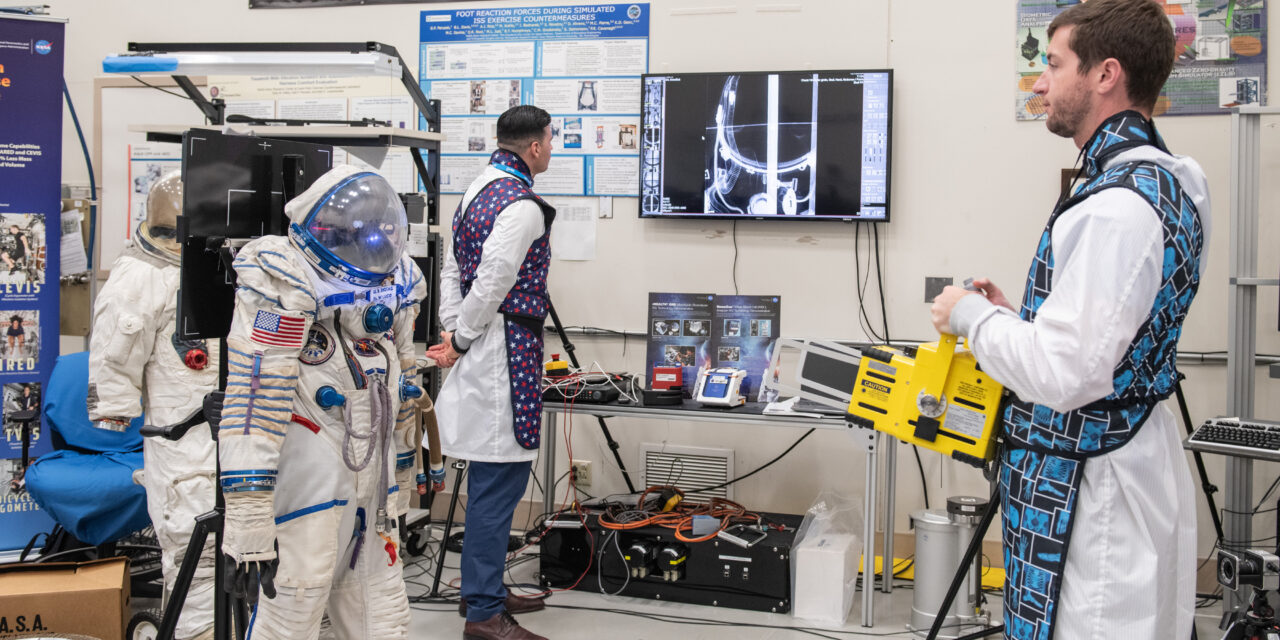
Three units are being evaluated for long-distance space travel, with potential applications for both clinical and equipment diagnostics.
NASA has narrowed its search for a portable X-ray unit to three commercial systems for use in future human exploration missions to the Moon, Mars, and beyond. MinXray announced that its Impact System, a wireless digital X-ray system, is among the finalists currently undergoing a second round of testing.
The selection process began with a review of over 200 commercial systems based on criteria including size, weight, image quality, ease-of-use, cost, and safety. The final three units are now being tested at NASA’s Glenn Research Center in Cleveland.
The selected system will need to serve multiple functions in a resource-limited environment. “We’re working to provide evidence on why a mini-X-ray system should be included in future space exploration,” says Dr Chase Haddix, a senior biomedical engineering research contractor working for Universities Space Research Association at NASA Glenn. “These X-rays could be used to detect both clinical and non-clinical diagnostics, meaning they can check an astronaut’s body or identify the location of a tear in an astronaut suit.”
Proven in Extreme Environments
According to MinXray, its Impact system is designed for portability with battery power and full-body imaging capabilities in a compact form factor. The system was recently used during the Fram2 mission in April, where it captured the first human X-ray image ever taken in space.
This capability to perform in harsh conditions is a key consideration for remote medical applications. “The Impact system has proven its capabilities in the most extreme environments from the base camp at Mount Everest to the deserts of Africa to high-elevation research centers in the rainforest of Papua New Guinea,” says Mike Cairnie, director of global and military sales at MinXray, in a release. “The Fram2 mission was another step toward proving diagnostic images can be captured in any conditions, a goal that is shared by the scientists at NASA as they look to expand medical care capabilities in the final frontier.”
Researchers at NASA expect to make a final selection by the end of 2025. The chosen system is scheduled to be tested aboard the International Space Station in 2027 or early 2028.
Photo caption: MinXray’s Impact System
Photo credit: MinXray