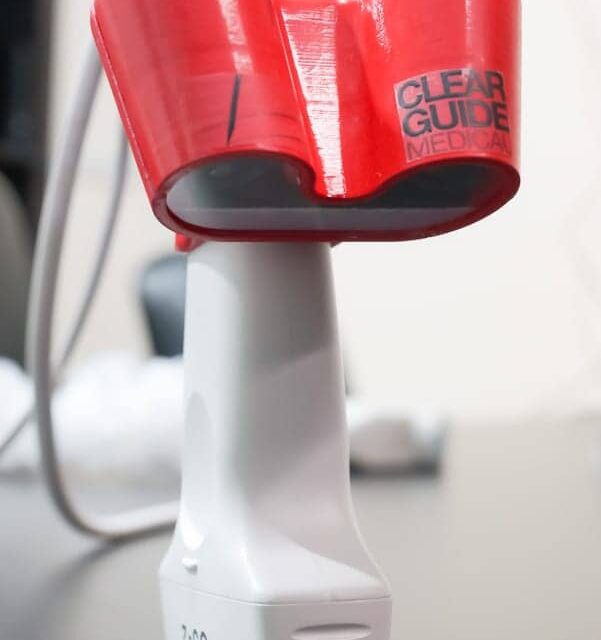
 Clear Guide Medical has received a 2-year SBIR Phase II research award of $1.5 million from the National Institutes of Health (NIH) to simplify ultrasound-guided procedures for a wider range of specialists. Based in Boston, the company develops innovations to provide computer-assisted image guidance for needle-based interventions. According to Clear Guide, the purpose of its research is to make ultrasound imaging for needle insertions an increasingly widespread tool across a range of clinical specialties.
Clear Guide reports that the combined ultrasound imaging skills and hand-eye coordination necessary to perform needle procedures are not easy to acquire and therefore ultrasound guidance does not get used by all clinicians. The NIH-funded project is intended to provide a new feedback method that will assist doctors in maintaining the correct probe and needle alignment relative to the clinical target, making it easier to use ultrasound simultaneously with needle insertion. This project will substantially increase the availability of doctors using ultrasound imaging to insert needles into the body, says Clear Guide, thereby increasing efficiencies and reducing adverse outcomes.
A clinical collaboration with Paul E. Bigeleisen, MD, professor of anesthesiology in the University of Maryland Department of Anesthesiology, will test the new device as part of the SBIR award. The award also includes a subcontract with Allison M. Okamura, PhD, of Stanford University. Okamura’s research focuses on developing the principles and tools needed to realize advanced robotic and human-machine systems capable of haptic (touch) interaction, particularly for biomedical applications.