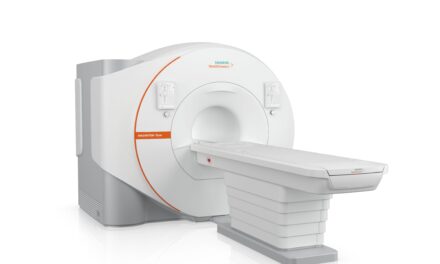

The project adds 40,000 square feet to Siemens Healthineers’ sole global manufacturing site for PET detectors used in its PET/CT scanners.
Siemens Healthineers Molecular Imaging has completed a $43.6 million construction and renovation project at its positron emission tomography (PET) Detector Center in Rockford, Tennessee.
The project added 40,000 square feet of new space to the 97,000-square-foot campus and renovated 7,500 square feet of existing space, the company announced. The Rockford site serves as the sole manufacturing location worldwide for the PET detectors utilized in Siemens Healthineers PET/computed tomography (PET/CT) scanners.
Expanding Production and R&D Capacity
The construction and renovation centered on the Dunavant Drive portion of the campus incorporates:
- An additional 36,000 square feet of dedicated manufacturing space
- A renovated 7,500-square-foot section within the 26,000-square-foot PET detector manufacturing and engineering facility
- A 4,000-square-foot expansion of the 21,000-square-foot research and development (R&D) facility
The complex also contains a 50,000-square-foot crystal-manufacturing facility on Stock Creek Boulevard, which was not altered during this project, the company stated in a release. The Rockford campus currently employs more than 200 workers and is projected to create more than 90 manufacturing, R&D, and management positions over the next five years.
Siemens Healthineers received a $930,000 FastTrack Economic Development Grant from the Tennessee Department of Economic and Community Development to help offset costs associated with property acquisition, new construction, and retrofitting, according to the release.
Clinical Drivers Behind PET/CT Demand
The company reported that the facility expansion will allow it to satisfy growing customer demand driven by expanded clinical use of radiopharmaceuticals in theranostics for cancer, neurology applications including Alzheimer’s disease evaluation, and cardiac imaging. The expanded manufacturing footprint will also support upcoming PET/CT product line launches in the US and globally.
PET detectors register gamma-ray emissions after a patient receives a radiopharmaceutical injection, which PET/CT systems then convert into images showing metabolic activity to help clinicians assess disease states.
“This ambitious expansion and renovation of our Rockford PET Detector Center demonstrates our ongoing commitment to being global leaders in PET/CT technology,” says James Williams, PhD, head of Siemens Healthineers Molecular Imaging, in a release. “This building project significantly increases production capacity and customer access to our PET/CT scanners to meet the rapidly growing worldwide clinical demand for PET/CT imaging. We are grateful to the state of Tennessee for the FastTrack Economic Development Grant that has supported this project, which will bring new jobs to the greater Rockford area.”
Energy Efficiency and Site Infrastructure
The project also integrated environmental measures, according to Siemens Healthineers. Upgrades include carbon-neutral equipment powered by electricity instead of gas, interior LED lighting fixtures, and 12 charging stations for electric vehicles.
To manage campus energy efficiency, Siemens Healthineers collaborated with the Tennessee Valley Authority, the largest public power provider in the nation, the company noted.
Photo caption: PET Detector Center in Rockford, Tennessee
Photo credit: Siemens Healthineers