The alliance will test a compact upright platform that could deliver either particle type, with helium ion therapy still needing clinical validation.
The University of Texas (UT) MD Anderson Cancer Center and P-Cure announced a strategic alliance to develop and clinically validate a particle therapy platform that delivers both proton and helium ion therapy from a single compact, upright treatment system.
The partnership pairs UT MD Anderson’s expertise in radiation oncology, particle therapy, and translational cancer research with P-Cure’s US Food and Drug Administration-cleared compact proton therapy platform. The organizations will evaluate the clinical, biological, and operational potential of a dual-modality approach that could let physicians choose proton or helium ions based on the characteristics of each patient’s disease.
If the effort succeeds, it would produce the first helium particle system in North America.
“As clinicians and researchers, we are committed to exploring technologies that have the potential to improve outcomes and expand access to advanced cancer care,” says Steven J. Frank, MD, executive director of technology and innovation for radiation oncology at UT MD Anderson, in a release. “This collaboration provides an opportunity to evaluate an innovative particle therapy platform while advancing our understanding of the potential role of helium ion therapy in cancer treatment.”
A Phased Approach to Helium Ion Research
The alliance will start by focusing on the clinical value, patient benefits, and operational advantages of P-Cure’s compact upright proton therapy solution. Building on that work, the partners will pursue preclinical and clinical programs to investigate helium ion therapy and generate the evidence needed to support clinical adoption, regulatory approvals, and reimbursement pathways.
The collaboration will include clinical evaluation of P-Cure’s proton therapy platform, preclinical studies of the biological advantages of helium ions, and future clinical studies to define optimal treatment applications.
According to the organizations, helium ions are emerging as a promising next-generation modality that may offer improved dose conformity, reduced lateral scattering, and enhanced biological effectiveness. The collaboration seeks to determine whether those characteristics can translate into better patient outcomes. Proton therapy, by comparison, has demonstrated meaningful clinical benefits across multiple cancer types.
“Helium therapy has the potential to become the next major advancement in particle therapy,” says Michael Marash, CEO of P-Cure, in a release. “Together with UT MD Anderson, we aim to establish the clinical evidence for helium ions while creating a practical path to make both proton and helium therapy accessible to far more patients worldwide.”
Compact Design Aims to Widen Access
Unlike conventional systems built around a single particle type, the long-term goal is a compact upright platform that can deliver either proton or helium ion therapy. The organizations say this flexibility could help physicians tailor treatment based on tumor location, disease characteristics, and therapeutic objectives.
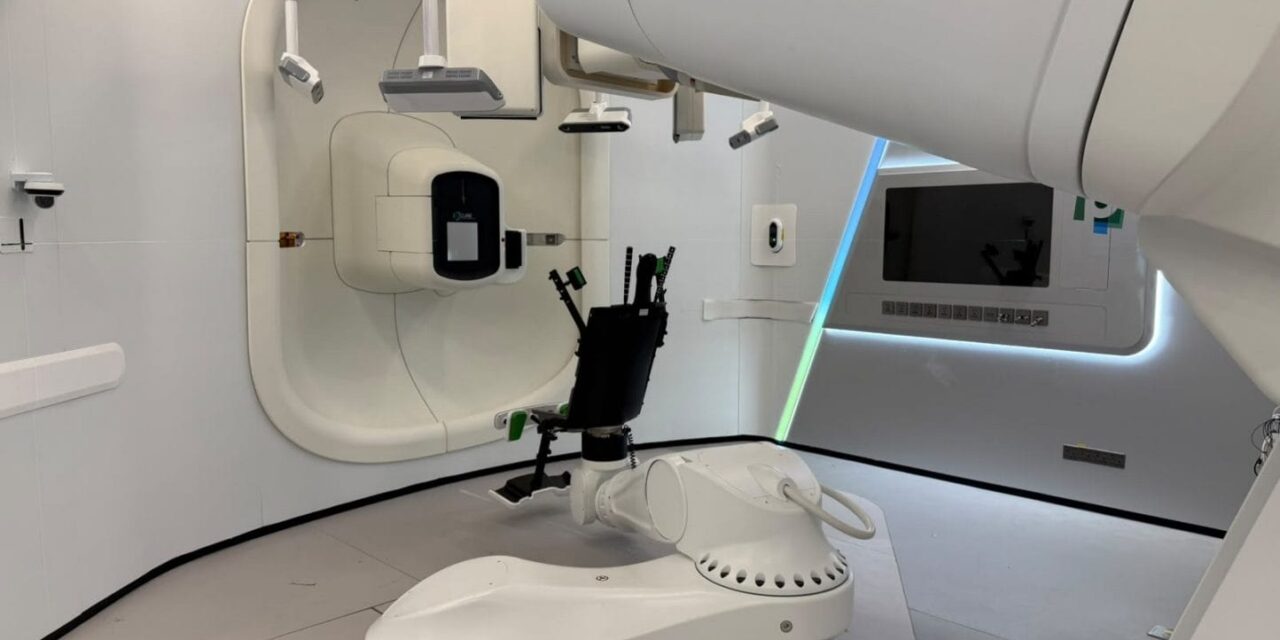
P-Cure’s platform uses an upright treatment architecture designed to significantly reduce the size, cost, complexity, and infrastructure requirements of traditional particle therapy facilities. The collaborators believe the combination of compact design and future multi-particle capability could make advanced particle therapy accessible to a much broader range of hospitals and cancer centers worldwide.
Under the agreement, UT MD Anderson is eligible to receive payments based on the achievement of certain clinical milestones and commercial sales. UT MD Anderson has an institutional conflict of interest with P-Cure, which will be managed under an institutional conflict of interest management and monitoring plan.
Photo caption: P-Cure’s compact, gantry-less proton therapy system
Photo credit: P-Cure