
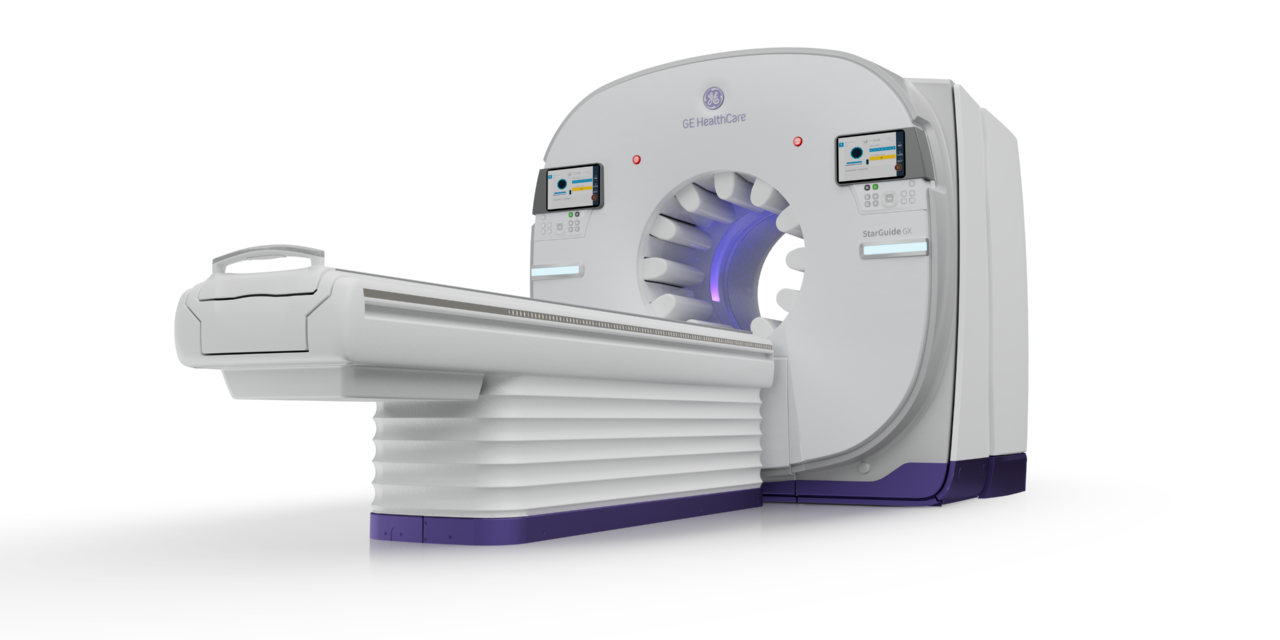
The system is designed to support nuclear medicine imaging and the growing use of targeted radioligand therapies.
GE HealthCare announced that its StarGuide GX digital single photon emission computed tomography (SPECT) and computed tomography (CT) system is 510(k) pending with the US Food and Drug Administration (FDA). The regulatory submission follows the system’s recent CE mark clearance in Europe.
According to a press release, the SPECT/CT scanner is designed to support nuclear medicine departments during the growth of theranostics, an approach combining targeted diagnostic imaging with therapy. The platform can image across multiple energy levels, enabling clinicians to acquire data from conventional nuclear medicine agents as well as emerging alpha-emitting radioligand therapy isotopes such as actinium-225 and lead-212.
“We are seeing a meaningful evolution in precision care, driven in large part by the continued growth of theranostics and the integration of imaging and targeted therapies,” says Ken Herrmann, chair of the department of nuclear medicine at University Hospital Essen, in a release. “As new tracers—including the anticipated development of alpha-emitting agents —expand what’s possible in diagnosis and treatment, it is essential that imaging technology evolves alongside them. Having systems that can accurately capture, quantify and support these advances will be critical to enabling more personalized care and improving patient outcomes.”
Detector Upgrades and Workflow Efficiencies
The StarGuide GX utilizes dual-sided cadmium zinc telluride detector technology engineered to provide double the volume sensitivity while preserving spatial resolution, according to the manufacturer. The company reports that this configuration allows clinical teams to capture diagnostic detail with shorter patient scan times.
The equipment also integrates Nvidia RTX computing architecture to assist with image reconstruction and expedite delivery of results, according to the company release.
To improve physical workflow inside imaging suites, the system features a patented dual-collimator design that completes collimator exchanges in less than three seconds, the release noted. GE HealthCare stated that the automated mechanism eliminates the requirement for storage carts and reduces the floor space required for accessory hardware.
“StarGuide GX reflects the future of nuclear medicine, where flexibility, speed and quantitative accuracy are essential,” says Erez Levy, executive director of molecular imaging at GE HealthCare, in a release. “It is designed to act as an all-in-one system and support advanced imaging techniques and emerging tracers, aiming to provide a powerful tool for clinicians looking to expand clinical capabilities and deliver personalized care.”
Addressing Targeted Radionuclide Therapies
The platform’s introduction comes amid growing healthcare sector investments in targeted radioligand treatments. Alpha-emitting therapies release high levels of radiation over localized cellular paths, which helps limit radiation exposure to healthy surrounding tissue, according to GE HealthCare.
As these agents enter broader clinical use, healthcare institutions require imaging instruments capable of quantifying isotope distribution to assist with therapy planning, individual dosimetry, and clinical research evaluation.
“With StarGuide GX now 510(k) pending in the US and CE Marked in Europe, we are advancing a new generation of molecular imaging technologies designed to support the growth of theranostics and precision care, aiming to help clinicians confidently adopt new and evolving tracers, expand clinical practice and deliver more personalized care to every patient,” says Jean-Luc Procaccini, president and CEO of molecular imaging and computed tomography at GE HealthCare, in a release.
Photo caption: StarGuide GX
Photo credit: GE HealthCare