
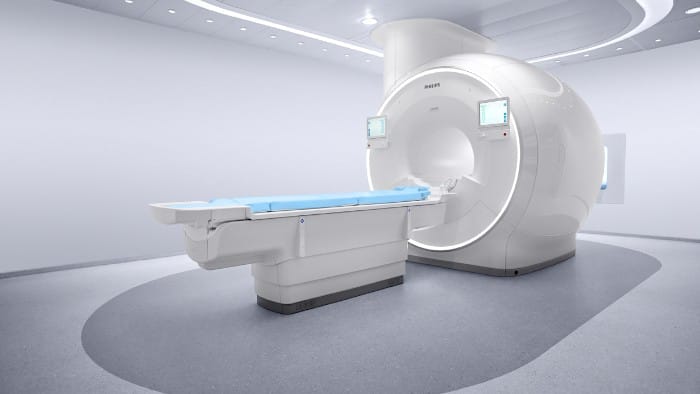
The solution combines a 1.5T MRI platform with MR-compatible mapping, monitoring, and catheter technologies to support radiation-free cardiac procedures.
Royal Philips and Imricor Medical Systems have introduced a new interventional magnetic resonance lab solution—iMR—designed for cardiac procedures on the Philips 1.5T MRI platform. The commercially available configuration integrates the imaging platform with a portfolio of compatible systems and consumables, allowing for an image-guided workflow during cardiac interventions without compromising field strength.
While catheter ablation is an established treatment for cardiac arrhythmias, many procedures currently rely on X-ray fluoroscopy, which exposes patients and clinical teams to ionizing radiation and provides only indirect visualization of soft tissue. The use of MRI in these interventions is intended to help physicians guide therapy more precisely, assess treatment response during the procedure, and identify potential therapy gaps before a patient leaves the room.
MRI has already improved cardiac diagnosis by enabling clinicians to visualize cardiac anatomy and tissue in exceptional detail, according to a release from Philips. “Bringing that same level of tissue insight into intervention has the potential to help physicians guide therapy more precisely, assess treatment response during procedures and identify potential therapy gaps before a patient leaves the procedure room—all within a radiation-free work environment,” the release reads.
Integrated Technologies and Siting
The solution includes the Philips Cardiac MR Suite, featuring artificial intelligence-powered cardiac planning and imaging applications, alongside Imricor’s NorthStar mapping and guidance system, the Advantage-MR EP Recorder/Stimulator, and the Vision-MR family of electrophysiology catheters. These technologies allow physicians to visualize anatomy, track catheters, and perform electroanatomical mapping within the 1.5T environment.
The platform is built on Philips’ BlueSeal helium-free technology, which reduces siting complexity and allows for installation closer to cardiology departments. This design is intended to support current adoption while establishing a foundation for future guided procedures.
“With interventional MR, the idea is not to move procedures into diagnostic MRI suites, but rather to bring MR imaging into the procedure room, a room we call an iMR lab,” says Steve Wedan, CEO of Imricor, in a release. “Pairing Philips’ world-class 1.5T MR platform with Imricor’s exclusive portfolio of advanced iMR systems and interventional tools creates the world’s first state-of-the-art high-performance iMR lab solution.”
The iMR solution is available immediately in CE-marked markets and in specific configurations within the US. Additional configurations are expected to become available in the US and other markets following further regulatory clearances.
Photo caption: iMR
Photo credit: Royal Philips