Technical experts deliver specialized instruction on portable life-support systems and deployable imaging equipment to military maintainers.
US Army Medical Logistics Command is providing hands-on training to military maintainers to bridge the gap between fielding new medical technology and sustaining it in the field.
The command recently held training events at Fort Bragg in North Carolina and Joint Base Lewis-McChord in Washington to ensure medical equipment remains operational in deployable environments, according to a release from US Army Medical Logistics Command.
Instruction for Portable Life Support
At Fort Bragg, biomedical equipment specialists received manufacturer certification training for the MOVES SLC, a portable life-support system. The unit combines an oxygen concentrator, ventilator, suction system, and vital signs monitor into a single battery-operated device. Because the system generates oxygen from surrounding air rather than relying on pressurized tanks, it is designed for use in remote environments where resupply is difficult, the release states.
The training session was facilitated by the Forward Repair Activity-Medical program, which provides direct maintenance support and instruction to tactical units.
“Creating a more autonomous BMET culture regarding troubleshooting and skills sets has benefited the relationships and notoriety of the FRA-M operation,” says Anthony Cruz, site lead for the Fort Bragg Forward Repair Activity-Medical, in a release.
The certification course provided trainees with a detailed understanding of the device, covering the theory of operations, mechanical breakdown, and hands-on troubleshooting.
“This training ensures these maintainers can effectively service and sustain the equipment, which is critical for enabling Forward Resuscitative Surgical Detachments to provide medevac and prolonged field care in austere, deployable environments,” says Dominique Taylor, a logistics assistance representative with the US Army Communications-Electronics Command, in a release.
Deployable Diagnostic Imaging
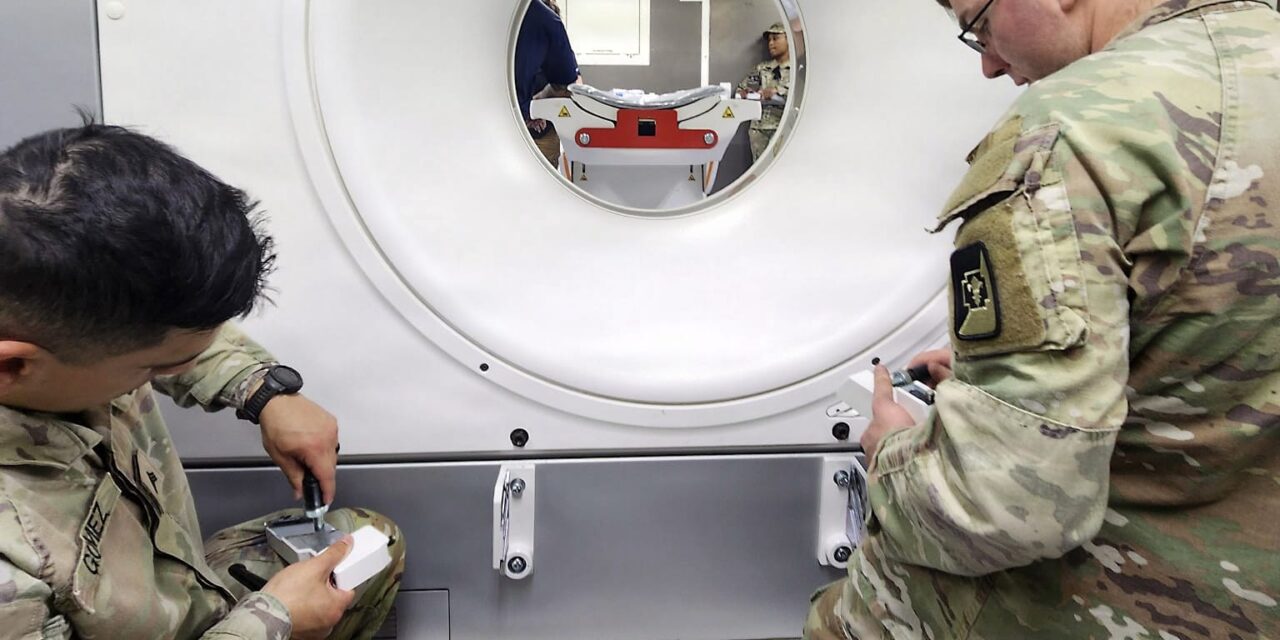
At Joint Base Lewis-McChord, personnel partnered with the 147th Field Hospital to train on the Army’s newest deployable computed tomography X-ray system. The system is housed inside a specialized shelter built to the dimensions of a standard shipping container.
Maintainers learned to transport, level, and expand the shelter. This process is critical because the scanner’s internal sensors will not allow operation unless the surface is perfectly level. The shelter also features lead-lined walls for radiation safety, which adds weight and complexity to the setup.
“This is a highly sophisticated piece of medical equipment, and it only works if the crew knows how to keep it up and running,” says Fernando Gonzalez, a biomedical equipment technician and instructor, in a release. “Our goal was to make sure these Soldiers can troubleshoot and maintain this scanner themselves, so they have complete confidence in the system when lives are on the line.”
The training was supported by experts from the Medical Maintenance Operations Depot in Tracy, California, with additional technical backing from depots in Utah and Pennsylvania.
“This fielding was a true team effort across the entire medical maintenance enterprise,” says Isaac Newman, director of the Medical Maintenance Operations Depot-California, in a release.
According to the command, these training initiatives are essential for maintaining high equipment readiness across the force.
“Properly trained Soldiers in the field directly equate to high equipment readiness, ensuring that life-saving systems are fully operational and ready to support the warfighter at a moment’s notice,” says Alfred Zamora, deputy director of the Forward Repair Activity-Medical program, in a release.
Photo caption: Soldiers from the 147th Field Hospital at Joint Base Lewis-McChord, Washington, practice troubleshooting the Army’s newest deployable computed tomography X-ray system during a training event hosted by medical maintenance experts from US Army Medical Logistics Command this past May.
Photo credit: Anthony Cruz