Despite vastly different resources, clinical engineering leaders at a rural hospital and a large health system are finding ways to expand their in-house capabilities while making outside service partnerships work.
By Alyx Arnett
At Northern Inyo Healthcare District in Bishop, California, a two-person clinical engineering department supports approximately 1,700 medical devices across a 25-bed critical access hospital and several outpatient clinics. More than 2,000 preventive maintenance procedures and roughly 1,800 unscheduled requests pass through the department each year.
Nearly 3,000 miles away, RWJBarnabas Health in New Jersey operates on an entirely different scale. Its clinical engineering program supports more than 132,000 devices across 12 hospitals and hundreds of outpatient locations, with dedicated teams for biomedical equipment, imaging systems, radiation oncology, and other technologies.
Despite their considerable differences in staffing and resources, both departments take the same approach: Keep as much medical equipment service in-house as possible.
For Edgar Newell, assistant vice president of clinical engineering at RWJBarnabas Health, keeping medical equipment service in-house saves money. But he says there’s more to having an internal team than the financial benefits.
“We’re a part of the community and culture there,” Newell says. “We don’t look at nurses as our customer; we look at nurses as our colleagues. Our mission is the patient in the bed.”
At Northern Inyo, Scott Stoner, manager of clinical engineering, has another reason to prioritize in-house service. The hospital’s remote location means outside service technicians are often hours away.
“When a field service engineer is four or more hours away, we have to consider more than the cost of the repair. Response time, parts availability, and extended equipment downtime can directly affect hospital operations and patient care,” Stoner says. “Having qualified technical staff on-site allows us to respond immediately and minimize those disruptions.”
How In-House Service Works at Different Scales
At RWJBarnabas Health, Newell oversees an extensive internal service operation that includes imaging engineers, radiation oncology engineers, biomedical technicians, and teams responsible for beds and other hospital technologies.
That breadth of expertise allows the health system to maintain most of its equipment without comprehensive outside service contracts. Newell estimates that only 3% to 4% of its equipment inventory is covered by such agreements.
“We try to do as much in-house as we can,” he says.
The health system’s size helps make that possible. Newell says having enough equipment of a particular type can justify investing in specialized technicians rather than relying on manufacturers or third-party service providers. For example, RWJBarnabas maintains more than 20 linear accelerators, making it more cost-effective to employ its own radiation oncology engineers.
At Northern Inyo, in-house service looks very different. With just two people in the clinical engineering department, Stoner and his colleague handle a broad range of maintenance and repairs rather than specializing in particular types of equipment. With limited backup equipment available, their familiarity with how devices are configured and integrated into the hospital’s clinical workflows helps them troubleshoot problems quickly.
“Because our team works with these systems and clinical departments every day, we understand how the equipment is configured and how it supports patient care,” he says. “That institutional knowledge often allows us to identify and resolve problems quickly.”
When Outside Service Makes Sense
Although both leaders favor in-house service, they still rely on outside providers for certain equipment and maintenance needs.
At RWJBarnabas Health, Newell says the organization maintains outside service contracts for its two CyberKnife systems because it doesn’t have enough of them to justify investing in specialized in-house expertise.
For its da Vinci surgical robots, however, the health system pays for service as needed rather than maintaining contracts. Newell says that the time-and-materials approach saves money.
For equipment that needs more frequent maintenance, a service contract may be more cost-effective. Newell points to large automated laboratory analyzers as one example.
“You have that usually under contract because they’re in there all the time servicing it,” he says. “Doing that [on a time-and-materials basis] will cost you a fortune more. But doing that under a contract, again, it’s situational.”
At Northern Inyo, Stoner makes similar decisions based on the expertise his small department can provide and the cost of outside service. The hospital relies on outside providers for some MRI, CT, and other imaging equipment that requires specialized training. It also maintains an OEM service contract for its Dräger anesthesia equipment, although Stoner’s team handles initial troubleshooting.
The hospital also maintains an OEM service contract for its STERIS sterilizers as replacement parts “can represent a substantial portion of the cost of maintaining the equipment,” Stoner says. He adds, “We look at the total cost of ownership rather than simply comparing contract prices against hourly labor rates.”
With labor included in the agreement, the contract also helps reduce the workload on his two-person department. Stoner says the hospital and STERIS have developed a flexible arrangement based on the urgency of service needs.
“Routine service can often be scheduled with some flexibility, but when an equipment failure threatens surgical operations, timely support becomes critical,” he says.
Using Partnerships to Expand Internal Capabilities
Outside service does not always mean transferring responsibility for equipment to another organization. In some cases, Newell says working with outside providers can help HTM departments develop expertise they can eventually use themselves.
At RWJBarnabas Health, the organization sometimes places newly acquired imaging equipment under an initial service contract while internal engineers learn the technology. A new CT model, for example, may require additional training before the team can take over routine maintenance.
Newell says the goal is to use that initial contract period to “learn the device and learn what we need to do.”
RWJBarnabas also maintains master service agreements with manufacturers such as Philips, GE HealthCare, and Siemens. Newell says the agreements provide access to training, discounted replacement parts, and reduced labor rates when outside assistance is needed.
At Northern Inyo, manufacturer training has helped the clinical engineering team take on more maintenance responsibilities. When the hospital switched to Hamilton ventilators, Stoner sent his colleague to training in Reno, Nevada.
“He was able to get the tools necessary and the service documents and manuals and make the relationships up there that we need moving forward,” Stoner says.
The training allowed the department to take over ventilator maintenance previously handled by a third party. Stoner estimates that the investment paid for itself in less than a year compared with the cost of a service contract.
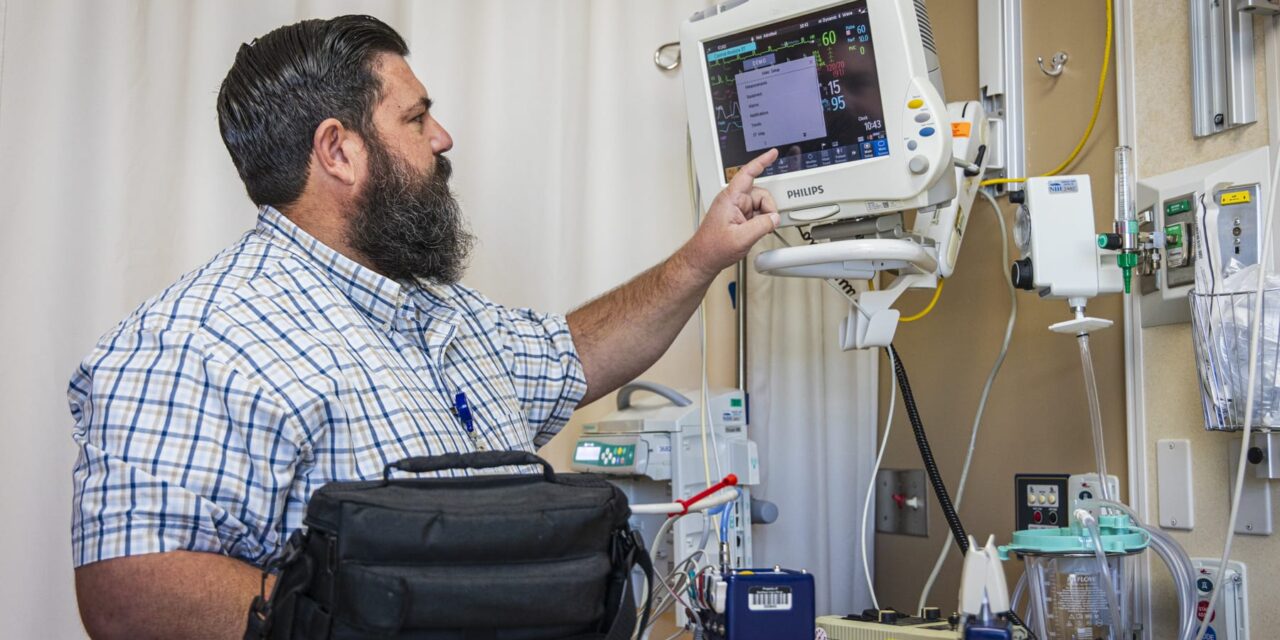
Stoner also received training on the hospital’s Philips IntelliVue patient monitoring systems, allowing him to troubleshoot problems in-house.
Choosing an Outside Service Provider
At RWJBarnabas Health, Newell says choosing an outside service provider starts with determining whether the company can deliver what it promises.
“We run into the used car salesman,” he says, describing when vendors advertise capabilities they cannot provide. He says he values companies that are upfront about their limitations rather than agreeing to work they aren’t equipped to handle.
The health system also audits its service providers to make sure they’re meeting expectations. Newell says occasional problems are understandable, but repeated failures can put a contract at risk.
“We’re going to give you an opportunity to get it right,” he says. “You’re not getting it right, and we’re done. We’re going to cancel the contract.”
RWJBarnabas includes performance measures and termination provisions in its service agreements. Those measures may cover scheduled maintenance completion, promised cost savings, or other expectations specific to the arrangement. For connected medical devices, Newell says cybersecurity responsibilities, including software updates and vulnerability management, have also become important considerations.
At Northern Inyo, Stoner also prioritizes technical competence, communication, and a willingness to collaborate with the in-house team.
“The best partners don’t treat clinical engineering as a barrier,” he says. “They recognize that we can collect logs, perform immediate hands-on diagnostics, isolate failures, and provide detailed knowledge of the local environment before a field engineer even gets on the road.”
He says that preparation can help the technician arrive with the necessary parts, potentially avoiding a second trip to Northern Inyo’s remote location.
Cost also factors into Stoner’s decisions, but he says a lower quote from a competing provider doesn’t automatically mean Northern Inyo will switch vendors. Instead, he gives existing service partners an opportunity to review their pricing.
“We have a responsibility to remain fiscally responsible. When pricing becomes a concern, I generally prefer to give an existing service partner the opportunity to review their proposal before considering alternatives,” he says. “We’ve found that open communication often allows us to control costs while preserving successful working relationships.”
Maintaining the Right Balance
Even with an extensive in-house service team, Newell says RWJBarnabas must continually reassess when outside support makes sense. New equipment can introduce technologies his engineers haven’t yet been trained to maintain, while staffing needs and service costs can change the value of an existing arrangement.
“It’s always on a part of our minds. For those of us who have to do the strategic planning and things like that, it’s a constant conversation piece,” he says.
At Northern Inyo, Stoner hopes to maintain the balance his department has established, preserving the knowledge and experience of his on-site team while continuing to draw on outside specialists.
“The absolute best service model would be complementary skills, and not really a one-size-fits-all,” Stoner says.
Photo caption: Scott Stoner, manager of clinical engineering at Northern Inyo Healthcare District, works on a Philips IntelliVue patient monitor.
Photo credit: Northern Inyo Healthcare District
Alyx Arnett is chief editor of 24×7 Magazine. Questions or comments? Email [email protected].