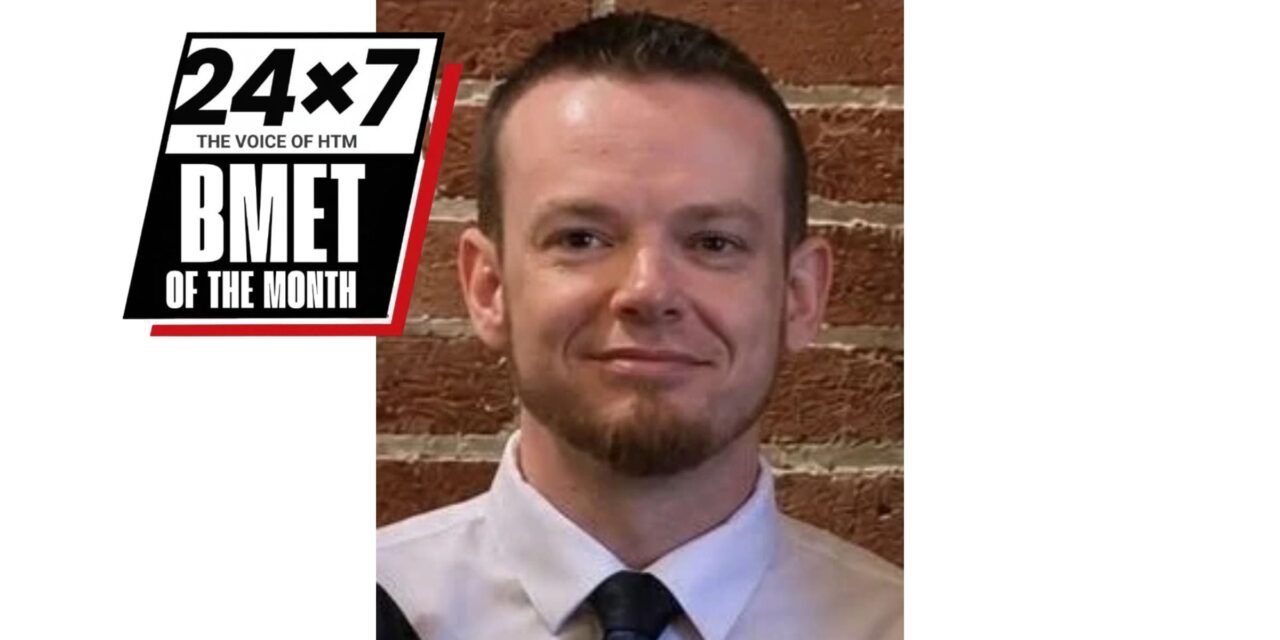
From building a biomed department from the ground up to troubleshooting equipment in busy operating rooms, Moffett shares what he’s learned along the way.
24×7’s BMET of the Month series highlights the biomedical equipment technicians who help keep medical equipment safe, functional, and ready for patient care.
This month, we spotlight Josh Moffett, a biomedical equipment technician at Kansas City Orthopaedic Institute in Leawood, Kansas, who helped establish the facility’s biomedical engineering department. Moffett reflects on the challenges of building the program and why mentoring others has made him a better technician.
What drew you to the biomed field, and what has kept you interested in it?
I’ve always been interested in electronics and have a knack for troubleshooting. I love the process of learning how a system works, identifying what part of it isn’t working, and making it work again. Knowing I would get to use those skills and interests to ultimately help people get better care really sealed the deal for me. Keeping up with advancements in medical equipment technology and test equipment keeps me interested and engaged with the work we do as BMETs.
What was it like helping build a biomed program from the ground up, and what did that experience teach you?
It was like drinking from a fire hose. From learning everything I didn’t know about CMMS platforms to researching and selecting a fleet of test equipment, the amount of information I had to process was overwhelming at times. The greatest challenge was keeping up with PMs and documentation while gathering the information we needed to build out our new system. I tracked everything via Excel spreadsheets in those days and we relied heavily on an ISO partner until our tools and test equipment were ready to go. I’m a recovering tool addict, though, so getting the opportunity to outfit a biomed shop from scratch was a lot of fun.
The experience taught me two things. First, strong leadership and support make an enormous difference, and I’ve been fortunate to have both. Second, no one succeeds alone. Throughout my career, I’ve benefited from people who generously shared their knowledge and experience. Being able to turn to those people for guidance in this endeavor reinforced how important it is to pay that forward whenever I have the opportunity.
You support equipment across everything from ORs and inpatient care to urgent care and off-site physical therapy clinics. What keeps you on your toes the most?
Without question, the operating rooms. Our OR schedules run tight, so I’m often ducking into an OR during turnover, trying to fix an issue and get out of there before they bring the next patient in. It really puts the pressure on when you have an entire OR team watching your every move, wondering if they’re going to stay on schedule.
What’s one of the most satisfying problems you’ve been able to solve as a biomed?
Our CRNAs kept reporting false occlusion alarms from their syringe pumps. For a long time, I couldn’t reproduce the problem. Every time I tested a pump, the occlusion alarm functioned exactly as it should, yet the reports kept coming in. I checked every mechanism and component I could think of, observed procedures, tested different syringes and tubing configurations, and spent I don’t know how many hours trying to find the root cause.
Eventually, I discovered when a 20 mL syringe was paired with microbore tubing and connected to the Y-port on a standard IV tubing set, the flow resistance was enough to trigger an occlusion alarm even though the line wasn’t actually occluded. The solution itself wasn’t complicated once the cause was understood, but the process of systematically working through the possibilities and finally uncovering the answer was incredibly satisfying.
What part of being a biomed has challenged you to grow the most?
Training and mentoring others. There’s nothing quite like teaching to expose gaps in your own understanding. When someone asks “why?” or “how does that work?” you quickly find out whether you truly understand the subject or if you’ve simply become comfortable performing a task. Filling those gaps has helped me become a better technician, communicator, and leader.
When you’re not working with medical equipment, what are you most likely to be doing?
Trying to keep up with my three crazy boys. Skateboarding, bike riding, fishing, digging in the backyard—it’s all a blast with them.
Know a biomed who deserves to be featured? Nominate them for 24×7’s BMET of the Month by emailing [email protected].