The technology, developed by Johns Hopkins University researchers, identifies sepsis cases up to 48 hours earlier than traditional methods and has reduced mortality rates by 18%.
The US Food and Drug Administration (FDA) has cleared an artificial intelligence (AI)-based early warning system designed to detect sepsis, one of the deadliest infections for hospital patients.
Developed by Johns Hopkins University researchers and commercialized by Bayesian Health, the tool is among the first AI-based medical technologies to receive clearance for this application, according to a release from Johns Hopkins University. The system identifies sepsis hours faster than traditional clinical detection and has reduced hospital deaths by nearly 20% in clinical settings, according to the release.
“Pre-suspicion screening is what creates lead time, and lead time is what changes outcomes in sepsis. Once a clinician already suspects sepsis, the clock has been running—often for hours or even days,” says lead researcher Suchi Saria, PhD, a Johns Hopkins professor and director of the AI & Healthcare Lab, in a release. “No other cleared test or device monitors for sepsis prior to clinician suspicion.”
Sepsis is often difficult to diagnose because common symptoms, such as fever and confusion, are associated with various other medical conditions. Delayed detection significantly decreases survival rates for the more than 250,000 people who die from the immune response each year.
To address these delays, the Targeted Real-Time Early Warning System integrates electronic health records with clinical AI to help doctors spot sepsis cases two to 48 hours earlier than traditional methods. According to data from dozens of hospitals across the United States, the system is reducing sepsis mortality rates by 18%.
“It gives physicians an additional set of eyes and ears and could genuinely help save lives,” says Albert Wu, MD, PhD, a Johns Hopkins expert in patient safety and a co-investigator on the work, in a release.
In 2023, the technology was deployed at several health systems under the FDA Breakthrough Designation, including Cleveland Clinic, MemorialCare in California, and University of Rochester School of Medicine. During this period, the system significantly reduced in-hospital mortality, morbidity, and length of stays for patients with sepsis, according to a release from Johns Hopkins University.
“Few clinical AI systems can reason across the full breadth of messy, real-world hospital data and deliver guidance clinicians can reliably act on,” says Saria in a release. “FDA approval is a regulatory first that shifts what the standard of care can be for a condition associated with roughly one in three in-hospital deaths.”
The FDA clearance also allows hospitals using the system to receive Medicare and Medicaid reimbursement under the New Technology Add-on Payment program, which compensates facilities for the use of new technologies.
“Suchi’s work has reached a major milestone,” says Ed Schlesinger, PhD, dean of Johns Hopkins Whiting School of Engineering, in a release. “It’s poised to have a significant role in preventing hospital deaths and complications.”
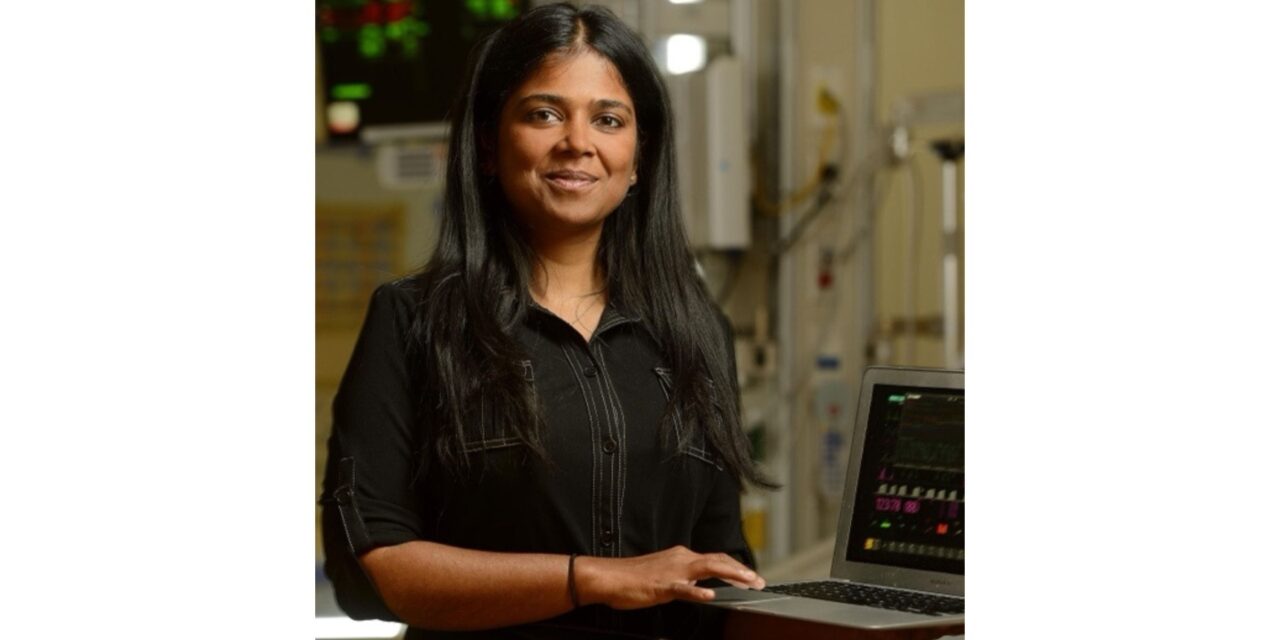
Photo caption: Suchi Saria, PhD, a Johns Hopkins professor and director of the AI & Healthcare Lab
Photo credit: Johns Hopkins University