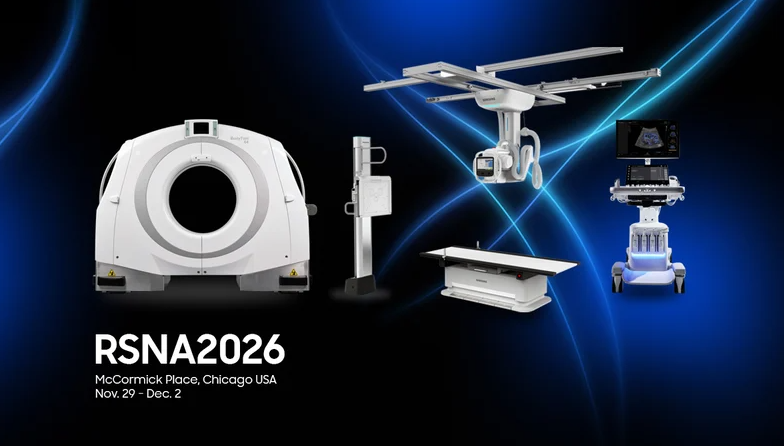
The company’s RSNA 2026 lineup includes a ceiling-mounted radiography system, a common software architecture across ultrasound platforms, and mobile CT technology.
Samsung Healthcare will introduce the GC85A Fit, a semi-automated, ceiling-mounted radiography system, at the 2026 Radiological Society of North America Annual Meeting. The company will also present changes to its ultrasound portfolio, including a shared software architecture across its systems.
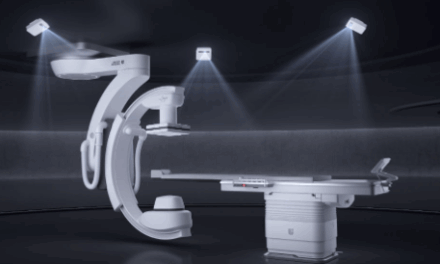
The GC85A Fit is designed for emergency and trauma departments, orthopedic practices, and general radiography environments. Samsung says the system pairs intuitive workflows with high-quality imaging to support efficient daily exams. Flexible configurations and an adaptable design are meant to fit different room layouts and operational needs, and to allow for future expansion.
“Listening to our customers and understanding their evolving needs is fundamental to how we approach innovation at Samsung,” says Jeyul Chang, head of sales and marketing team, health and medical equipment business at Samsung Electronics, in a release.
One Software Foundation Across Ultrasound Systems
Samsung has unified its ultrasound portfolio under a common software architecture that spans premium to compact systems. Sonographers and radiologists often scan on different systems from site to site. A consistent experience across touchscreens and workflows is intended to provide familiarity and reduce training time across fleets, according to the company.
The shared foundation also enables faster development and migration of new technologies across the portfolio. The ultrasound systems run Windows 11 and use an advanced computing architecture built for enhanced cybersecurity and AI scalability.
At the meeting, Samsung will show the following ultrasound products and features:
- The new X10 tablet ultrasound system, which features simplified workflows and extended battery-powered mobility.
- Updates to the R20 ultrasound platform, including AI-powered Deep USFF for liver fat quantification and viscosity imaging technology. Both are designed to support noninvasive assessment and management of liver disease.
- New AI Assist tools intended to streamline exams, improve reproducibility, and support clinical productivity.
Samsung notes that the X10, Deep USFF, and AI Assist products and features, as well as their availability, may vary by country and are subject to local regulatory approvals.
“Healthcare organizations shouldn’t have to choose between advanced imaging technology and responsible capital investment,” says Tracy Bury, chief commercial officer at Samsung Healthcare USA, in a release.
Mobile CT Also on Display
The exhibit will also feature Samsung’s mobile CT portfolio, which brings rapid CT imaging directly to the point of care.
BodyTom 64 combines battery-powered scanning with the flexibility to move between care settings without fixed installation. Its 85 cm bore, independent workstation, and Instant Repeat capability are meant to support efficient imaging workflows.
OmniTom PCD uses photon-counting detector technology to deliver high-resolution imaging at low radiation doses. Samsung says the technology supports a broader range of image analysis and diagnostic capabilities.
Photo caption: The company’s RSNA 2026 lineup
Photo credit: Samsung Healthcare