
From installing dental X-ray systems to maintaining more than 3,500 medical devices, Naval Hospital Pensacola’s biomedical equipment technicians keep equipment safe, calibrated, and ready for patient care.
At Naval Air Station Pensacola, in a Naval Branch Health Clinic dental treatment room sized for a single patient, a vacant space on the wall lies exposed wires and an empty plastic mold that seems as if it were meant to hold an object. This space marks the spot where an X-ray unit will soon be installed. Cardboard boxes and plastic bags filled with various parts such as an extension arm, control panel, and tube head lay on the ground waiting to be assembled.
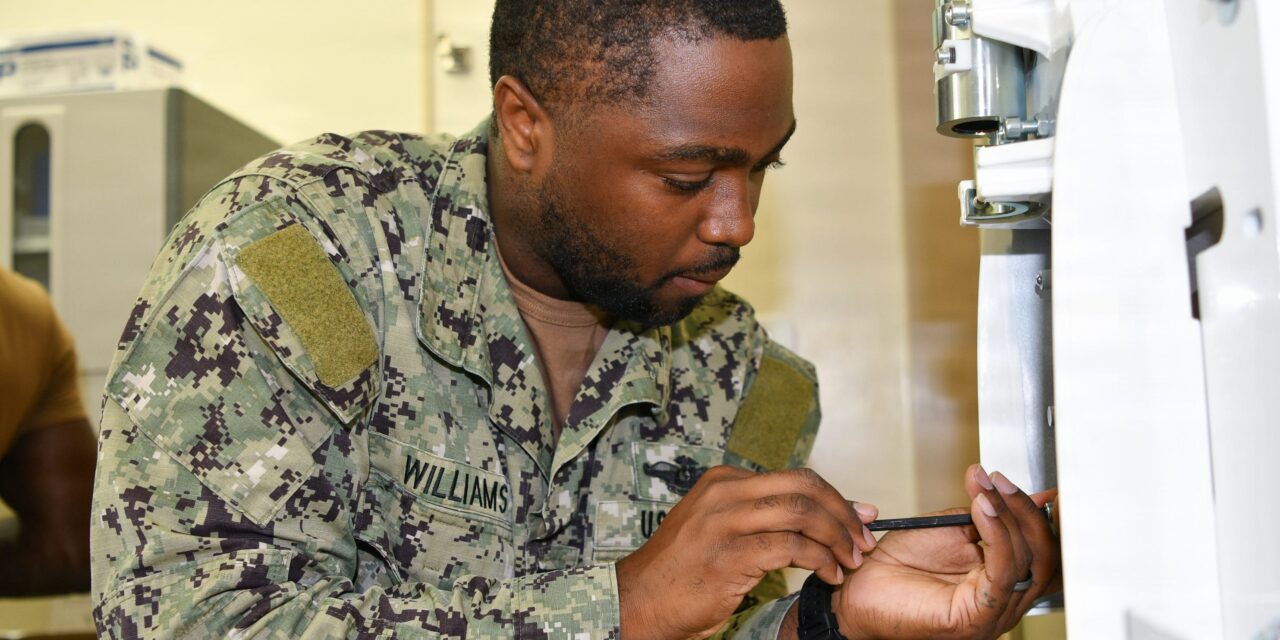
A specialized team is in charge of bringing this equipment online. Hospital corpsman 2nd Class Khalil Williams, hospital corpsman 2nd Class Brentkyle Cabrero, and hospital corpsman 3rd Class Samuel Toe are biomedical equipment technicians (BMETs) at Naval Hospital Pensacola, executing a work order to install the new dental X-ray unit.
Beyond maintenance and assembly, clinics depend on BMETs to ensure smooth daily operations by expertly installing and maintaining their essential medical equipment.
“Installing the dental X-ray unit allows the clinic to be fully medically ready ensuring providers and medical staff properly perform their job and carry out their duties,” says Cabrero.
Within patient care, the use of medical equipment is imperative. Providers rely on medical equipment to be ready and up to date, allowing them to consistently provide critical and accurate diagnosis and treatment.
“BMETs keep this place functioning, and they are always helping us see more patients by maintaining our operational readiness allowing us to send Marines and Sailors to the fleet,” says Lt Marissa Singh, an endodontist assigned to Naval Branch Health Clinic Naval Air Station Pensacola.
The clinic’s leadership’s trust and confidence in BMETs proves that these technicians are an indispensable piece in the operations of the military healthcare system.
“BMETs are crucial within the hospital system,” says commander David Berlin, officer in charge of Naval Branch Health Clinic
Naval Air Station Pensacola. “There are countless systems that need repair and upkeep. The BMET team is absolutely critical because they are trained to maintain those systems and get us back up and running.”
According to hospital corpsman 1st Class Christopher Carson, to manage this inventory the team operates on a rigorous, proactive schedule. At the start of each month, the maintenance manager assigns preventative maintenance work orders, all of which must be completed by the 15th. This structured schedule is constantly balanced against daily, unscheduled service requests for broken or malfunctioning gear.
“BMET takes care of the maintenance and calibration of all medical equipment located throughout NMRTC (Navy Medicine Readiness and Training Command) Pensacola,” says Carson. “All equipment undergoes electrical and physical inspections. We ensure the safety and usability of every piece of equipment that is going to be touched and used on a patient.”
This equipment includes everything from blood pressure units to X-ray machines throughout NMRTC Pensacola and its 10 branch clinics; roughly 3,500 pieces of equipment, says Carson.
The scope of their responsibility means Naval Hospital Pensacola BMETs frequently travel on temporary additional duty to Naval Branch Health Clinic Meridian, Naval Branch Health Clinic Gulfport, Naval Branch Health Clinic Belle Chasse, Naval Branch Health Clinic Mid-South, and more.
Whether at Naval Hospital Pensacola or on the road, BMETs utilize service manuals and literature provided by the manufacturer that allows them to inspect equipment at various intervals while calibrating them to industry standards. Furthermore, they can specialize their education and practice by attending service schools to work on specific pieces of equipment.
In life-or-death situations accurate data may be the pivotal factor for providers to make lifesaving decisions, while even minor discrepancies can compromise patient diagnosis and treatment plans.
“When your family gets hooked up to the machine, you want to know that the doctor is getting the right reading,” says chief hospital corpsman Rashad Mckenzie, leading chief petty officer of Naval Hospital Florida’s BMETs. “Things as simple as the vital signs machine and getting a diagnosis is crucial, if BMET isn’t meticulous in doing what they’re supposed to do, the machine won’t be reading correctly.”
The team’s efforts of maintaining medical equipment significantly support the command’s mission of providing quality health care. The often-unseen daily efforts and dedication of Naval Hospital Pensacola’s BMET’s are integral to delivering quality healthcare and maintaining operational readiness across the command’s various clinics.
“Being a BMET allows us to impact the fleet and the mission because of the equipment we maintain, repair, and install,” says Cabrero. “It allows the hospitals, clinics, and staff to reach more patients and help them stay healthy and get through their day.”
Although their contributions may not be recognized by patients, BMETs take great pride and value in their work, committing themselves wholeheartedly.
“We’re a behind-the-scenes type of a job,” says Mckenzie. “It is one of those thankless jobs because no one sees you until something is broken but I think it is one of the best NECs (Navy Enlisted Classifications) that corpsmen can do.”
Photo caption: Navy medicine readiness and training command Pensacola sailor, hospital corpsman 2nd class, biomedical equipment technician Khalil Williams, assigned to Naval Hospital Pensacola, installs a dental X-ray unit motherboard mount at Naval Branch Health Clinic Naval Air Station in Pensacola, Florida, on June 24, 2026.
Photo credit: US Navy photo by mass communication specialist seaman Jon Jezreel Andres