
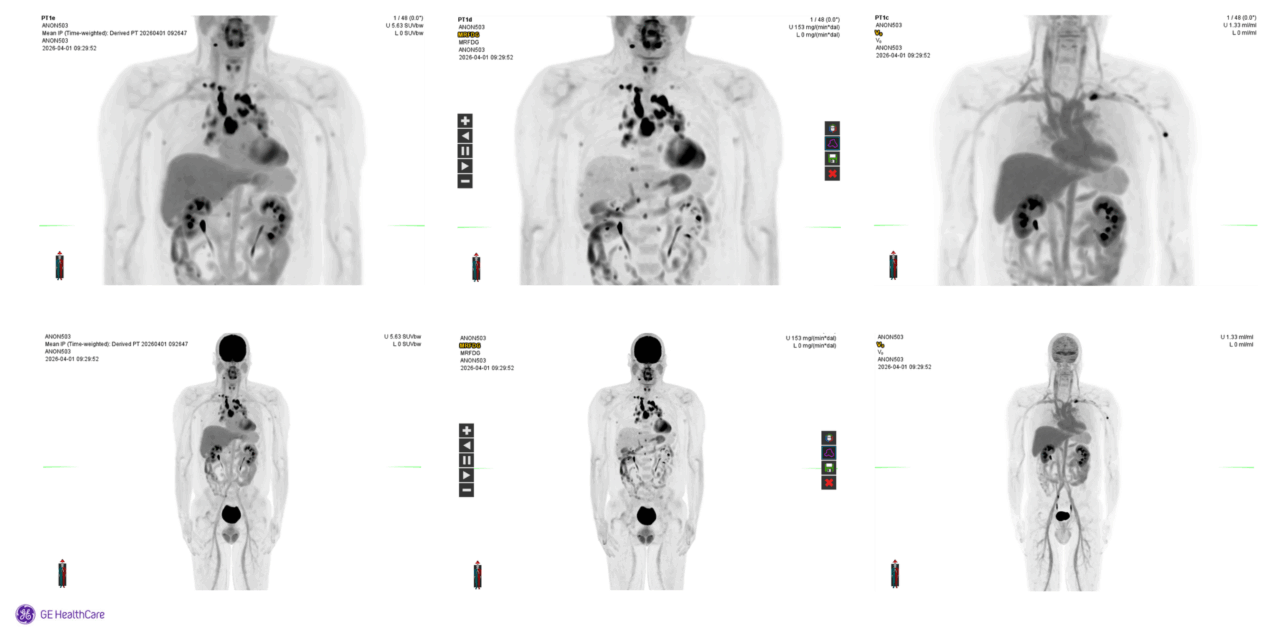
The MIM KineticID software is designed to provide quantitative insights into disease by tracking radiotracer movement over time.
GE HealthCare announced that its MIM KineticID modeling software is now 510(k) pending with the US Food and Drug Administration (FDA).
The software is engineered to enable dynamic PET workflows and kinetic modeling, providing a data-driven view of how radiotracers behave across the body over time. Traditionally, PET imaging relies on visual interpretation of static images and metrics such as standardized uptake value. Because these methods reflect a single point in time, they may not fully capture how a tracer behaves in the blood or tissue, according to GE HealthCare.
“Dynamic PET and kinetic modeling are transforming how we understand disease,” says Martin Huellner, MD, senior physician and vice director of the department of nuclear medicine at Zurich University Hospital, in a release. “Instead of relying on a single moment in time, we can track how a tracer moves through the body and uncover what’s driving what we see, providing a far more accurate and meaningful picture of underlying biology. This capability is increasingly valuable in clinical care and research, supporting applications in oncology, cardiology, neurology, and the development of new tracers and therapies.”
The MIM KineticID solution is designed to make dynamic imaging more practical for clinicians and researchers. It includes features for 4D visualization, Patlak analysis, and customizable curve fitting. By tracking radiotracer movement, the software aims to provide reproducible measurements of biological processes, including tracer uptake rate and metabolic activity.
“As healthcare advances toward more personalized care, the expectations for imaging are changing,” says J Anders, general manager of MIM at GE HealthCare, in a release. “Clinicians and researchers need tools that go beyond static images to deliver deeper, quantitative insight into disease biology. With MIM KineticID, we’re not only addressing today’s need for more accessible dynamic imaging, but also creating a platform that can adapt and scale as new tracers, therapies, and clinical questions emerge.”
The software also supports rapid whole-body dynamic analysis with automated labeling and flexible modeling tools for tracer concentration in plasma and tissue. It allows for side-by-side comparisons of multiple tracers to support collaboration and informed decision-making.
As part of the vendor-neutral MIM ecosystem, the software supports digital imaging and communications in medicine data from any PET system. The platform also enables multi-modality fusion, therapy response assessment, and integrated analysis to help streamline workflows and maximize the value of imaging data, according to the company.
Photo caption: MIM KineticID
Photo credit: GE HealthCare