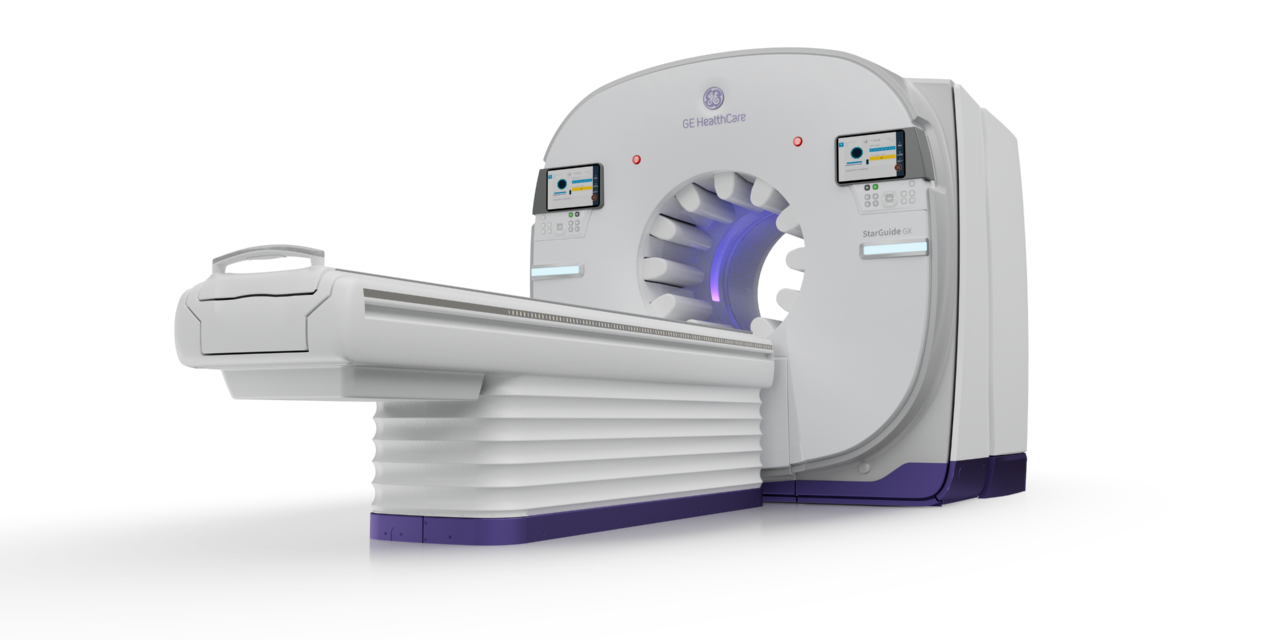
The global evaluation spans Hadassah, Mayo Clinic, Oncopole Toulouse, Peking University First Hospital, and Rambam, with more than 1,000 patient studies completed to date.
GE HealthCare has announced a global clinical evaluation program spanning three continents and five internationally recognized institutions to assess StarGuide GX, its next-generation digital 4D SPECT/CT system. The program was unveiled ahead of the European Association of Nuclear Medicine (EANM) 2026 Annual Meeting in Vienna, Austria.
Participating institutions include Hadassah Medical Center in Israel; Mayo Clinic in the United States; Oncopole Claudius Regaud – Institut Universitaire du Cancer de Toulouse in France; Peking University First Hospital in China; and Rambam Health Care Campus. Collectively, the sites will evaluate image quality, quantitative performance, dynamic imaging, and workflow, while contributing clinical and research feedback intended to shape future iterations of the platform.
“Nuclear medicine is entering a new era in which imaging is expected to do more than identify disease; it is increasingly being used to quantify biological processes, support treatment decisions, and monitor response to therapy,” says Erez Levy, executive director, molecular imaging, GE HealthCare, in a release. “By working across multiple regions and care environments, we aim to generate clinical and research insights that can help inform innovation as imaging, quantitation and workflow needs evolve.”
Platform Design and Capabilities
StarGuide GX uses dual-sided cadmium zinc telluride detector technology and is designed to support high-sensitivity, high-resolution imaging, quantitative imaging, and dynamic acquisitions. The detector configuration allows the detectors to move close to the patient during imaging, and a patented dual-collimator detector design is intended to eliminate the need for manual external collimator exchanges.
The system is engineered to support radionuclides across a broad energy range and, in research settings, may also be evaluated for imaging radionuclides associated with emerging alpha-emitter research, including Actinium-225, aimed at expanding theranostic applications. StarGuide GX uses NVIDIA RTX accelerated computing to support image reconstruction and includes a Low-Medium Energy collimator designed to provide up to 2.67-times system volume sensitivity compared with the NM/CT 870 DR with LEHRS collimator, as measured per NEMA NU-1 2023 with adaptations for StarGuide GX.
“The technological innovations introduced by StarGuide GX are particularly exciting for the future of theranostics,” says Frederic Courbon, head of the imaging department, Oncopole Claudius Regaud – Institut Universitaire du Cancer de Toulouse, in a release. “The system’s ergonomic design and flexibility have the potential to significantly improve workflow while supporting precision in quantitative imaging and high-energy radionuclide applications. Our first experience suggests that StarGuide GX represents a meaningful step forward in enabling advanced theranostic practices.”
Scope of the Global Collaborations
Each participating site will focus on distinct clinical and research applications:
- Hadassah Medical Center (Israel): Evaluate advanced quantitative capabilities following the system’s recent field upgrade.
- Mayo Clinic (US): Evaluate advanced quantitative and dynamic imaging applications.
- Oncopole Claudius Regaud – Institut Universitaire du Cancer de Toulouse (France): Assess StarGuide GX, the department’s general-purpose SPECT/CT platform, across routine oncology imaging and clinical research.
- Peking University First Hospital (China): Explore novel tracer research and preclinical applications.
- Rambam Health Care Campus (Israel): Evaluate StarGuide GX imaging workflows through extensive clinical use across a broad range of nuclear medicine applications and tracers.
The new collaborations build on GE HealthCare’s work with University Hospital Essen in Germany, which in June 2026 opened a new Nuclear Medicine Center featuring the world’s first installation of StarGuide GX SPECT/CT. To date, these institutions have scanned more than 1,000 patients.
StarGuide GX received CE Mark in November 2025 and is available for sale in select European Union member states. The system is 510(k) pending with the US FDA and is not currently available for sale in the United States. Investigational tracers evaluated through the program, including those tied to alpha-emitter research, have not been approved by the FDA or any other regulatory authority for clinical use.
Photo caption: StarGuide GX
Photo credit: GE HealthCare