Linax Technologies’ new SIMAC platform lets service engineers model beam behavior, trace anomalies, and train on a virtual linac without competing for vault time.
By Alyx Arnett
When a linear accelerator’s quality assurance report flags a field size out of tolerance, service teams may start with jaw calibration checks and spend beam time ruling out different subsystems before identifying the cause, according to Quinn Bartlett, general manager at Linax Technologies. The company is betting that a digital twin of the machine can change that process.
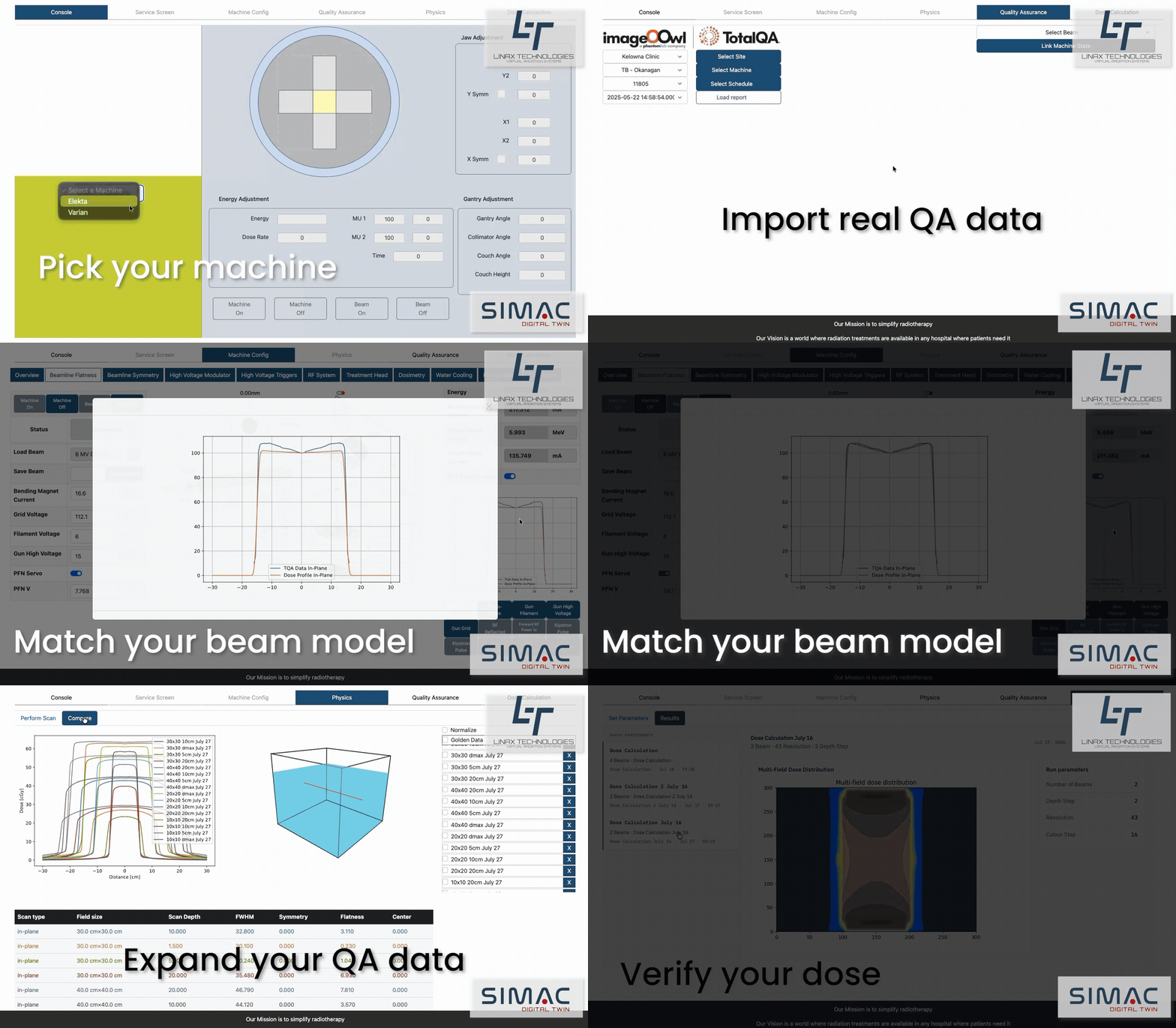
Linax Technologies’ new SIMAC Digital Twin platform is now available, creating a virtual model of a clinic’s linear accelerator using real QA data. The platform matches a virtual beam model to the machine’s current output and lets engineers manipulate parameters to see how the beam responds before making a physical change. It currently supports Varian and Elekta beam generation and photon delivery systems, with dose calculation limited to 4-field box plans and VMAT on the roadmap.
“The model gives you a hypothesis and a predicted outcome. Measurement on the machine still confirms the fix,” Bartlett says. For healthcare technology management teams responsible for keeping linacs available and accurate, Bartlett says changing that order of operations could mean less trial and error and less beam time spent diagnosing a problem.
Catching Drift That Passes Parameter-by-Parameter QA
Bartlett points to combined sub-threshold drifts as one type of problem the twin is designed to surface. When several parameters each move but remain within tolerance, standard QA can still report them as passing. According to Bartlett, the twin allows users to look at the combined effect on dose and treatment.
“If QA data shows drift across several parameters, each of which is still inside tolerance, operators can see what the combined effect of those drifts will be on dose and on treatments,” Bartlett says. “That combination is invisible to parameter-by-parameter QA.”
The same modeling can be used for root cause analysis, Bartlett says. When anomalies appear, engineers can work backward from the QA data to the machine configuration to determine which parameter, subsystem, or part may be driving the deviation.
Rethinking the Troubleshooting Workflow
Bartlett offers an example: a 20×20 field size out of tolerance, a small symmetry error still inside tolerance, and profiles that differ between collimator 0° and 180°. A conventional QA report, he says, would flag the field size without identifying the cause.
“The likely path from there is a jaw calibration check, possibly a service call, and some amount of beam time spent on the wrong subsystems before anyone looks at steering,” he says.
With the twin, Bartlett says the model fit can instead look for the parameter state that explains all three observations. In his example, that points to a reduction in position steering coil current. The engineer can adjust that parameter virtually and check whether the predicted profiles, field size, and collimator behavior return to baseline before touching the machine.
“What changes in the process is the order of operations,” Bartlett says. “Today you often must open the machine to form a hypothesis. Here you form the hypothesis, test it against the physics, and go in with a specific target.”
Bartlett says the approach should mean less trial-and-error component swapping and less beam time spent on diagnosis. He also says two engineers looking at the same data should arrive at the same hypothesis, which he says is not reliably the case today.
A Shared Object for Service and Physics
The twin is also designed to sit at the handoff between service engineers, who cover beam generation, and medical physicists, who manage dose transport. Bartlett emphasizes that it does not change where authority over the machine resides.
“Dosimetric acceptance and release of the machine stays with the physicist, and the twin sits outside the treatment planning system as an independent verification model,” he says. “What changes is that the conversation starts with one shared object, instead of two sets of notes.”
Training on a Machine Engineers Can Break
Bartlett identifies access to training and the time required to train as two barriers to building in-house linac service teams. The recognized route is OEM training, which he describes as expensive and “weighted heavily toward procedure rather than the underlying beam generation theory, so technicians come out able to follow a process but not always able to reason through an unfamiliar fault on their own.”
Linax offers courses that are designed to allow technicians to stay in-house while training. Bartlett says the pathway is designed to take someone with no linac experience to servicing independently within a year.
The twin handles the hands-on portion by giving trainees “a machine they’re allowed to break.” Engineers can shift steering coil current or increase radiofrequency pulse width and see the predicted effects on output, flatness, symmetry, and dose without competing for vault or treatment time.
What’s Next
Linax is also developing a lifecycle management feature that will use parameter history by subsystem and the dose consequence recorded alongside each event. Bartlett says tracking beam models across multiple machines over time could create a reference distribution that “turns drift from an observation into a judgment: This magnetron is drifting faster than comparable units.”
The platform is available now as a full set or as individual modules covering data import, machine configuration, and dose calculation. Data import currently runs through the TotalQA by Image Owl API, with a manual import path in development for clinics that don’t use Image Owl.
Photo caption: Digital Twin overview
Photo credit: Linax Technologies