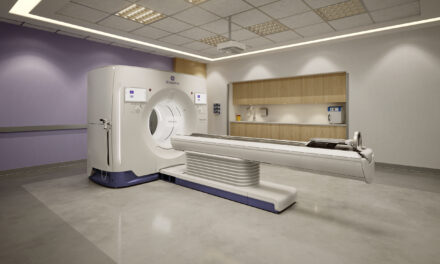
The software is designed to enhance spatial resolution and suppress artifacts in pulmonary, musculoskeletal, and inner ear scans.
GE HealthCare has received 510(k) clearance from the Food and Drug Administration (FDA) for True Definition DL, a deep learning reconstruction solution for computed tomography (CT).
The technology uses a dedicated deep neural network to enhance spatial resolution and suppress artifacts, which allows for high-resolution CT imaging. The solution is designed to support fast scans and provide coverage for clinical areas such as pulmonary, musculoskeletal, and inner ear imaging.
“Image quality matters in healthcare—because when imaging performance is aligned with the specific diagnostic task, it plays a critical role in improving accuracy, enabling earlier detection, and guiding appropriate patient care,” says Chad Rowland, executive director of global premium CT and photon counting at GE HealthCare, in a release. “For clinicians, diagnostic confidence begins with the ability to clearly visualize subtle structures, differentiate tissues, and trust what is seen on the screen.”
The clearance comes as global health systems face an increasing demand for diagnostic imaging. According to the company, more than 80% of all health system visits include an imaging exam. Chronic disease rates are also rising, with the global cancer burden projected to increase by more than 75% by 2050 and cardiovascular disease prevalence expected to rise by nearly 90% due to aging populations and rising risk factors.
Building on Existing Deep Learning Tools
True Definition DL builds on the company’s existing portfolio of deep learning tools, including TrueFidelity DL and True Enhance DL. By using neural networks and high-performance computing, the technology provides sharper images and faster processing compared to traditional reconstruction methods.
“With new tools like deep learning at our disposal, the industry has entered a new era in which reconstruction methods are more accessible to a broad range of providers, delivering sharp, consistent images and enabling care teams to make timely, well-informed decisions that directly impact patient outcomes,” says Rowland in a release.
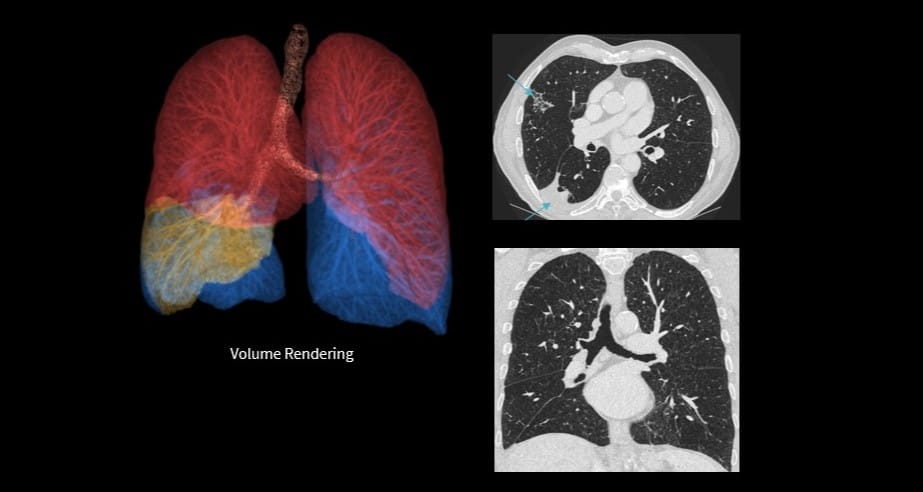
The technology is specifically designed to improve detail in high-contrast regions, such as lung tissue and bone structures in the inner ear. GE HealthCare introduced its first deep learning-based image reconstruction technology for whole-body imaging in 2019 and has since expanded the portfolio to include gated cardiac scan modes.
Photo caption: True Definition DL chest exam
Photo credit: GE HealthCare