Larry Fennigkoh reflects on what he got right in 1981, what he would revise today, and why self-awareness still matters.
By Alyx Arnett
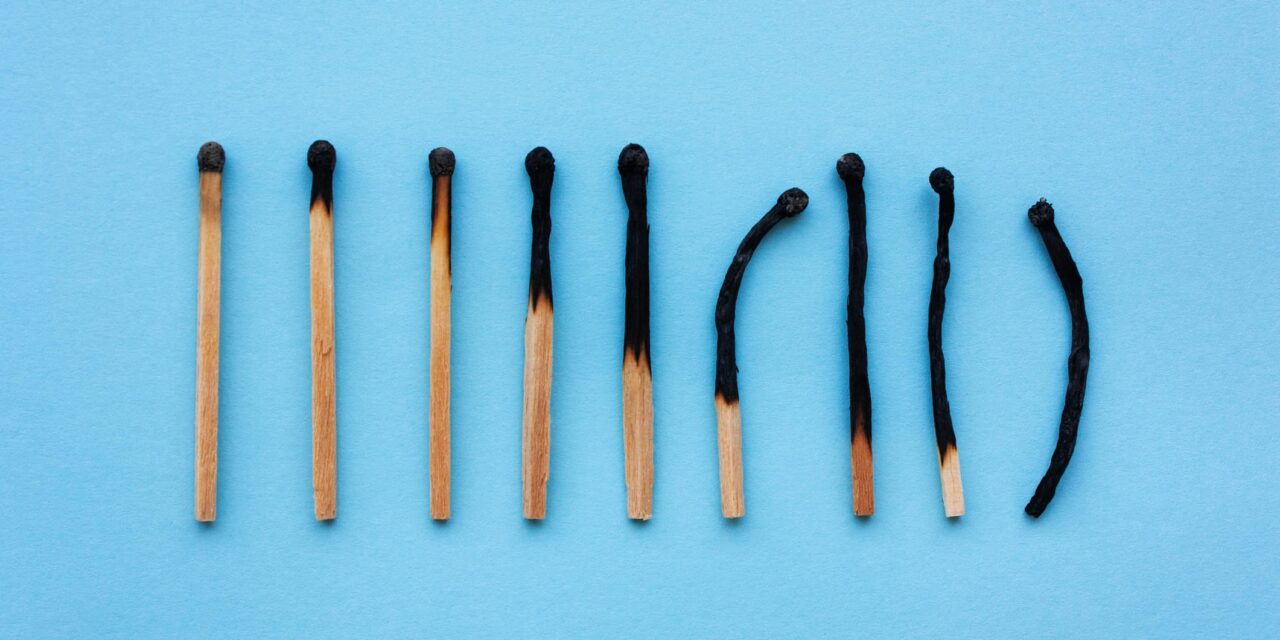
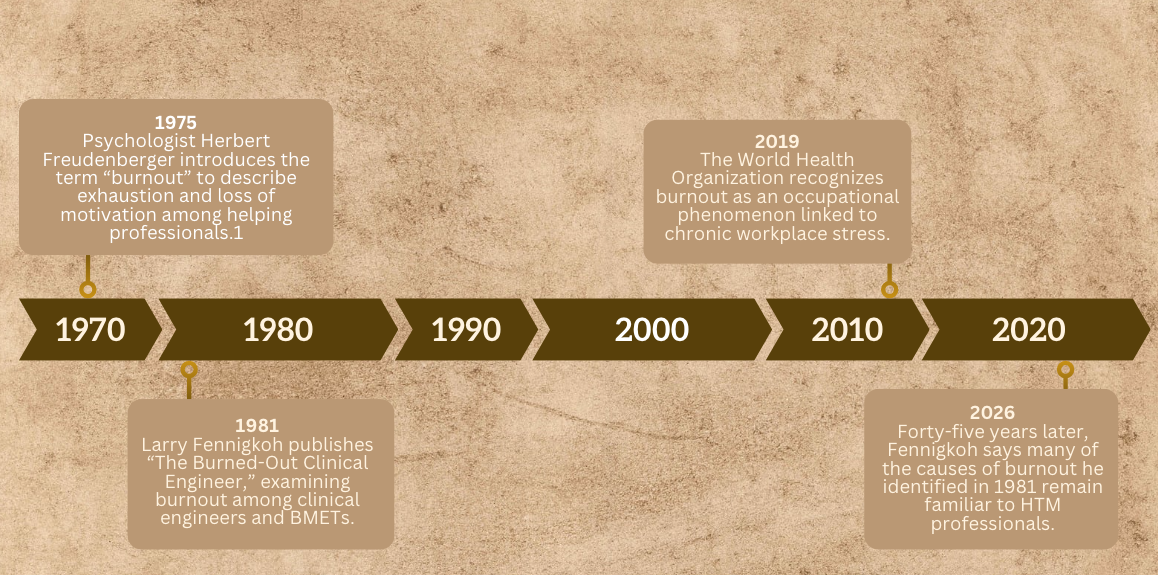
When Larry Fennigkoh, CCE, PhD, wrote “The Burned-Out Clinical Engineer” in 1981, clinical engineering was still working to define its place in the hospital. In the paper, published in Medical Instrumentation, he warned that burnout was pushing clinical engineers and biomedical equipment technicians (BMETs) out of hospitals and into industry, taking “a wealth of talent, leadership, and hard-earned experience” with them.1
Fennigkoh, now professor emeritus of biomedical engineering at the Milwaukee School of Engineering, says he first recognized the pattern after hearing burnout discussed in a behavioral psychology lecture in the late 1970s. “I was instantly struck by the parallels in symptoms between those in the helping professions and those among my clinical engineering and BMET peers,” he says. “Once-very-dedicated, enthusiastic professionals just seemed to disconnect, go flat, and, while still functional, become disturbingly apathetic.”
The article framed burnout as a mix of job-induced and self-induced factors. Fennigkoh argued that hospital-based clinical engineers often felt misunderstood, underused, underpaid, and treated as an extension of plant maintenance. He also wrote that the people most at risk were often the very people the profession needed most: enthusiastic, optimistic, committed professionals.
Four and a half decades later, Fennigkoh says much of the paper still feels familiar. “I was a bit surprised to see how etiology has remained fundamentally unchanged and quite timeless,” he says.
While the technology and day-to-day demands of the job look very different today, Fennigkoh says many of the underlying causes of burnout remain the same.
The Old Frustrations Still Sound Familiar
In the 1981 paper, Fennigkoh identified several job-related factors that could contribute to burnout among clinical engineers. Among them were feeling misunderstood or underused, being viewed as an extension of plant maintenance, receiving less recognition than other healthcare professionals, and facing a mismatch between professional expectations and hospital reality.
Fennigkoh says those concerns still surface when he talks with healthcare technology management (HTM) professionals today. “Consistently, the meetings I go to, invariably you’ll hear people, especially younger people, talking about the exact same thing we were talking about 40, 50 years ago,” he says.
Part of that, he says, stems from the nature of HTM work as a support function.
“The better, more effective the departments become, in terms of their workflow, their operations, their efficiencies, almost by default, they become increasingly more and more invisible,” Fennigkoh says. “The good HTM departments out there are doing precisely that with all the behind-the-scenes work that they do, keeping the technology up at an optimal level.”
Fennigkoh says that’s partly a sign of success. Clinicians should be able to focus on patient care without thinking about whether a device will work. The downside, he says, is that HTM often gets noticed only when something goes wrong.
“When something does fail catastrophically, or at the worst possible time, then literally all hell breaks loose,” he says. In those moments, Fennigkoh says, HTM staff can become “the instant scapegoat,” even when they responded quickly, or the root cause was outside their control.
Why the Most Committed People Can Be at Risk
One of the key arguments in Fennigkoh’s 1981 paper was that burnout affects people who are highly enthusiastic, optimistic, and committed. He argued that apathetic or undercommitted workers do not burn out in the same way; in the paper, he wrote that they “rust out.”
Looking back, Fennigkoh says he saw that pattern in himself and in younger staff members. “They come in just loaded with enthusiasm, commitment, energy,” he says. “Their investment, maybe, was so much greater that when they did experience a slight or something wrong, it had a much more devastating effect because they were so in love with what they were doing.”
The problem, he says, is the emotional impact of repeated mismatches between expectations and reality. In the paper, he expressed that idea as stress increasing when expectations do not match reality. One example, he says, is rushing to respond to a service call and expecting gratitude, only to encounter frustration from clinicians whose workflow has already been disrupted.
“That’s what, early in my career, messed with me the most—and multiple times almost made me quit,” Fennigkoh says. Over time, he says, he learned not to take those interactions personally and to pause before reacting emotionally.
More Devices, More Complexity, More Pressure
Although the emotional pattern may look familiar, Fennigkoh says the day-to-day technical environment has become far more demanding than it was in 1981.
In the original article, he wrote about a profession still trying to establish its role in the hospital. Today, he says, HTM teams support far more equipment, including networked devices with embedded firmware and software dependencies. “HTM programs today are dealing not only with many more devices, often in the thousands and tens of thousands, but also with increased complexity by similar orders of magnitude,” he says.
That complexity, he says, has made troubleshooting and repair more difficult, especially when support teams lack documentation or software tools. Fennigkoh connects that issue to today’s right-to-repair debates. At the same time, he says, device performance, safety, and reliability have improved markedly.
The result, in his view, is a profession that has gained technical responsibility while still wrestling with some of the same recognition and support issues he described decades ago.
“Navigating and managing all of this makes today’s healthcare environment drastically more demanding and stressful than healthcare was in 1981,” he says.
The Warning Signs Have Not Changed Much
In 1981, Fennigkoh described burnout as a progression from job disappointment to job disillusionment and, eventually, job disgust. He still sees value in that framework.
Early signs, he says, can include a drop in energy, less enthusiasm, more absenteeism or tardiness, and a loss of engagement. In the original paper, he wrote that one warning sign was when a clinical engineer “no longer gets excited over dead batteries in the defibrillator.”
Looking back, Fennigkoh says he did not always recognize burnout when it was happening. He recalls a dialysis technician who became increasingly detached over time.
“I literally had one person I had to fire,” he says. “The guy had gotten so flat, so apathetic, he just didn’t give a damn about anything anymore.”
At the time, Fennigkoh says he viewed the technician as a performance problem.
“I didn’t really understand burnout,” he says. “I didn’t understand what was going on, let alone how to counsel and work with the person to try to help him. Unfortunately, I put the blame on him. I wrote him off as just a disgruntled employee, as opposed to a casualty of the environment that we had all created.”
Today, he says, he hopes managers and department leaders are better equipped to recognize those early warning signs before burnout becomes severe.
What Still Helps
Many of the solutions Fennigkoh offered in 1981 still stand, he says. The most important, he says, is self-awareness.
“Just as your technical skills need to be regularly updated, refined, and enhanced, so does your emotional health,” he says. “Nurture and learn to pay attention to the often incredibly silent, often fleeting inner whispers of work-related frustration, loss, or sadness.”
He also still emphasizes real vacations. “The importance of just getting away from the workplace seems to be a key essential factor,” he says. That means leaving work behind, not checking email from a hotel business center or taking a laptop on vacation, he says.
Peer connection also remains important, he says. In 1981, he recommended peer group discussions and professional meetings. Today, he says local biomed groups, AAMI, and others can offer both continuing education and a sense of support from people facing similar challenges. He also found value in simple department lunches and other informal gatherings, which he says helped teams build trust before they had to navigate stressful situations together.
How the Conversation Has Changed
Fennigkoh says one of the biggest changes since 1981 is how burnout is discussed. At the time, he says, the emphasis was often on the individual’s resilience. Today, he says, organizations and leaders are more likely to recognize their own role.
“In the 1980s, the dominant theory seemed to be that if a professional burned out, they simply weren’t resilient enough, were too thin-skinned,” he says. “Today, the consensus is that burnout is a systemic management failure, not an individual character flaw.”
He points to the World Health Organization’s 2019 recognition of burnout as an occupational phenomenon as one sign of that shift.
Fennigkoh says HTM leaders should pay attention when employees start to change and ask questions before problems become disciplinary. He also says managers should examine the environment before blaming the person. “Conflating the symptoms of burnout with an attitude and performance problem” is a common mistake, he says. Instead, leaders should look at whether workflow, expectations, staffing, resources, or leadership style are contributing to the behavior.
Fennigkoh says he is more optimistic now than he was in 1981 because more organizations recognize the connection between workplace culture, retention, and employee health. He says HTM cannot afford to ignore burnout, especially when experienced professionals are difficult to replace.
“It’s more reason we have to take care of the people we have and not chew them up before their time,” he says.
References
- Fennigkoh L. The burned-out clinical engineer. Med Instrum. 1981;15(6):375-9.
ID 121691625 © Alexmia1 | Dreamstime.com
Alyx Arnett is chief editor of 24×7 Magazine. Questions or comments? Email [email protected].


To borrow from an old saying, it seems as much as some things have changed, others have stayed the same.
During my career, I was fortunate to be able to recreate my job several times at Johns Hopkins and then Mass General. I was able to do that in part because they were large academic centers that offered a breadth of opportunities to follow professional interests. I was also fortunate to work with and report to colleagues who recognized potential value in broadening horizons.
I wrote about aspects of that work in 24/7 over the years. I sort of saw myself as the beat who went over the mountain to see what I could see, and I felt both obligated and privileged to report back on it.
The business has changed. I’m almost completely out of touch with my former colleagues who are still working, but I know the circumstances are very different. Consolidation has been the norm for a while. If opportunities to explore new horizons were constrained before, the must be almost non-existent now.
Does any of the unhappiness felt by today’s CEs stem from that? If so, how can it be addressed?
Larry, I believe you have addressed that indirectly. I would summarize it as what may not be possible individually may be possible collectively. Examples:
A few months ago, I was considering writing an article on the various impacts of the accelerating rate of change of technology on the delivery of healthcare. Quite frankly, a set of theses could be written on aspects like user and servicer training and approaches to learning style. Examining that rabbit hole in detail is far too much for any one person.
Then there’s AI. I have no idea how that’s impacting clinical engineering. How does one accomplish V&V for systems capable of learning? What does learning even mean for those systems? Etc.
There is no profession within healthcare more capable of addressing these kinds of issues than clinical engineers. None. Period.
I recall a “Clinical Engineering Body of Knowledge” being published some years ago. Perhaps that needs to be revisited? And if so, when it’s completed this time it should more fully establish the professions domain and brand and be marketed beyond clinical engineering.
I once got into a shouting match with Frank Painter over people doing work like I was doing (which at the time included circuit design to extend or modify device capabilities) calling themselves clinical engineers. I told (yelled at) Frank that I wasn’t arguing that CEs needed to be design engineers but rather that they could be (under very limited circumstances, which my work was). My point was that extending the breadth and communicating that to the C-suite might alter their perspective re: what clinical engineering can accomplish for the organization.
I’ve defensively blathered here long enough. In closing …
Larry, I’m heartened to see you’re still going at it. I’m very serious about that. And as always, your writing covers a lot of ground succinctly.
I considerED myself a second generation CE, and I believe the field is up its fourth and fifth generation. I hope they figure a way to address the seemingly intractable problems you cite that have plagued us since the beginning.
Your story matters. Frank Painters’s story matters. Binseng Wang’s. Ethan Hertz’s. Bob Stiefel’s. Manny Furst’s. And so many others’ who my 71 year old brain is forgetting at the moment.
You guys laid the foundation. It’s still pretty solid. Share the stories proudly. Most importantly, share the whys. They’re the first principles. They remain valid.
I finally remembered Elliot Sloane and Steve Grimes.
I could add names from a list I’m sure i could find elsewhere, but I limited the list to people who influenced me directly (some may not want to be on the list, but that’s their problem).
Sometimes others’ stories lift people up. Maybe pointing student and early career CEs to some of Henry Petroski’s writings will strengthen their resolve during the difficult moments.
There. I’m done. Now back to retirement.
(It does feel odd to realize I’ve been retired for almost 10% of my time on this planet)