
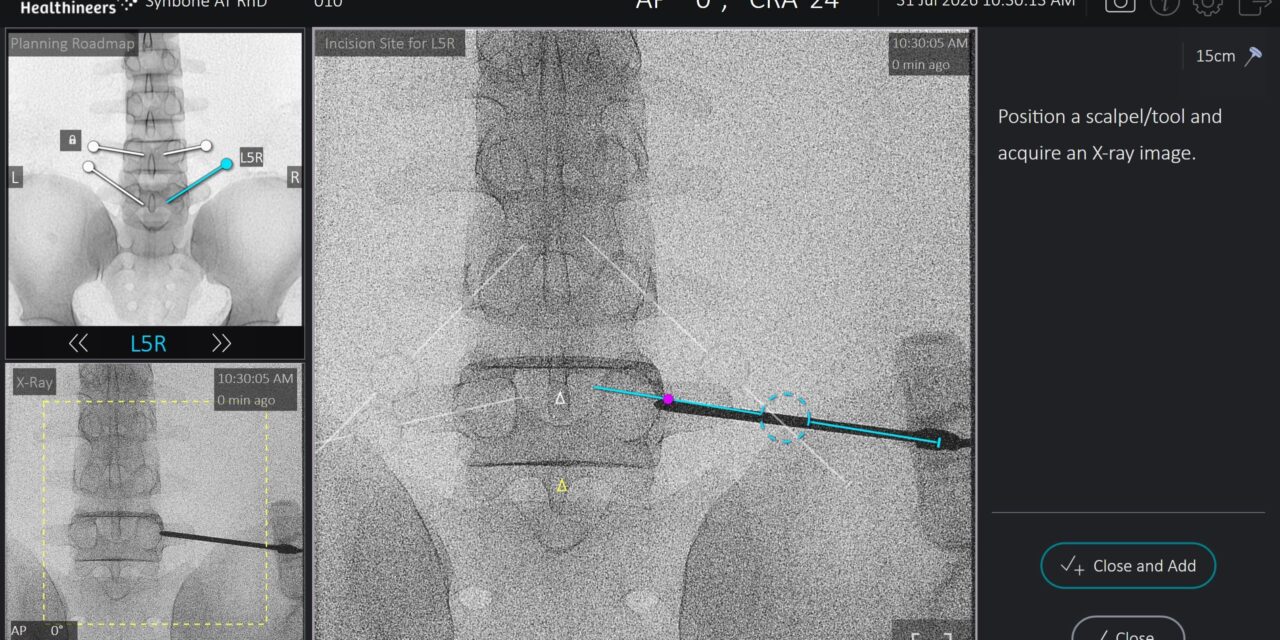
The software expands the Cios Spin mobile imaging system into surgical guidance without requiring external cameras, instrument trackers, or patient-mounted reference frames.
Siemens Healthineers has added Vuze guidance software for spinal operations into its Cios Spin mobile imaging system, according to a press release from the company. The software is designed to assist surgeons with guide wire placement for pedicle screws without relying on external tracking cameras, instrument markers, or reference frames attached to the patient.
Siemens Healthineers acquired Vuze last year after a collaborative partnership and plans to expand the software integration across its other two-dimensional mobile, three-dimensional mobile, and three-dimensional robotic systems in the future, according to the announcement.
According to the company, the software has received Food and Drug Administration 510(k) clearance for spinal fusion, fixations, vertebroplasty, and kyphoplasty procedures from vertebrae T7 to L5 in prone patient positioning.
“Our goal is to close the gap between conventional fluoroscopy and advanced optical navigation systems,” says Peter Seitz, head of image-guided surgery and robotics at Siemens Healthineers, in a release. “With Vuze, we expand what mobile C-arms can do in the operating room without adding complexity. Navigation technologies have proven their clinical value, and our vision is to bring that value within reach of every care setting, broadening access for guided spine surgery and complementing the ecosystem of guidance solutions.”
Streamlining Surgical Navigation and Setup
According to the press release, the software provides continuous intraoperative guidance during minimally invasive procedures by merging preoperative computed tomography or intraoperative cone-beam computed tomography scans with intraoperative fluoroscopic X-ray images. Conventional navigation systems often rely on optical line-of-sight cameras and specialized reference hardware that can increase setup times, equipment costs, and operational complexity, the company states.
“For 30 years, I’ve been waiting for a spinal navigation without tracking tools that fits into the way I already work,” says Veit Braun, head of neurosurgery at Diakonie Klinikum Jung-Stilling in Siegen, Germany, in a release. “Vuze may in the future deliver that: no separate workflow, no instrument trackers, no reference frames, no cameras, no line-of-sight requirements.”
Addressing Growing Procedural Demand
The integration comes amid rising procedural volumes for spinal stabilization and fusion. Minimally invasive spine surgery volumes in the US increased by an estimated 18.7% over the past year, according to market data cited in the release. Furthermore, the US population aged 65 and older is projected to grow from 58 million in 2022 to 82 million by 2050, according to Population Reference Bureau data cited by the company.
Misplaced screws during spinal procedures can lead to vascular, visceral, or neurological injuries. Laboratory testing on artificial spine models demonstrated screw placement accuracy of up to 96.7% using the software, according to an experimental study cited in the release. Additionally, pooled data cited in the release show that navigated techniques achieve a median placement accuracy of up to 95%, compared to 92% when using fluoroscopy alone.
“Through a successful proof of concept, we validated the combined solution, built trust between our teams, and established a strong foundation for future strategic decisions,” says Stefan Assmann, senior director of startup connect at Siemens Healthineers, in a release. “This journey highlights how successful acquisitions are often rooted in successful partnerships first.”
Photo caption: Vuze guidance software
Photo credit: Siemens Healthineers