
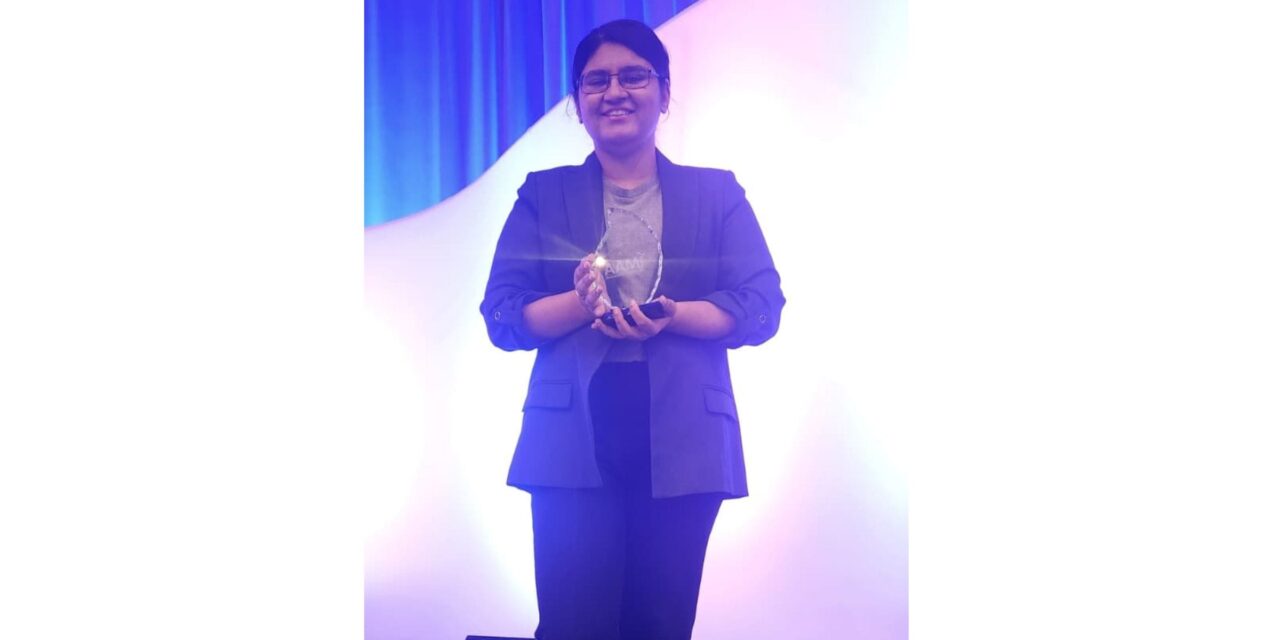
The 2026 AAMI Young Professional Award winner discusses the career path that led her into regulatory affairs and the challenges she hopes to solve next.
By Alyx Arnett
Attrayee Chakraborty, a senior quality systems engineer at Analog Devices Inc, has been named the recipient of the 2026 AAMI Young Professional Award for her contributions to medical device quality and AI regulation.
Throughout her career, she has helped organizations navigate regulatory and quality challenges related to emerging health technologies. Today, she leads a global quality AI council at Analog Devices while continuing her research and industry involvement outside of work in several professional organizations, including the International Society for Pharmaceutical Engineering GAMP Boston Chapter, Regulatory Affairs Professionals Society AI Collaborative Community, American Society of Quality Medical Device Division, Boston Congress of Public Health, and Institute for AI Governance in Healthcare.
“The community has been really open to me, and they’ve been very cooperative in helping me understand what are the problems out there. That is what has given me the motivation and intent to do what I do,” she says.
Entering the Compliance Space
Chakraborty’s introduction to regulatory affairs came while working in a research lab at the Indian Institute of Science in India. After becoming involved with a nearby startup incubator, she began helping graduate students navigate compliance requirements and bring products from the lab to market. The experience introduced her to the regulatory side of medical technology and set her on a new career path.
“That’s when I kind of found my calling,” she says.
She later moved to the United States to pursue a master’s degree in regulatory affairs. Since then, her work has spanned projects ranging from a surgical eye device at Mass General Hospital to a VR-based diagnostic tool. Her early experiences reinforced the importance of understanding the challenges facing regulatory and quality professionals, she says.
“The biggest thing that helped me in my journey so far is to know what gaps are there in the industry,” Chakraborty says. “It’s very essential to know what the pain points are which people face in their daily lives as regulatory and quality professionals, and that motivates me to come up with solutions.”
The Push for Harmonization
According to Chakraborty, one of the biggest challenges facing regulatory and quality professionals today is keeping pace with the growing number of AI-related regulations.
“Initially, we were at a state where there was no regulation, and there were questions around how do we regulate this,” she says. “Then it came to a stage where different countries have different kinds of regulations. And now we’re at a stage where you have too many regulations, and how do we harmonize these things so that products can roll out successfully?”
Today, she says, “The bigger questions being asked…are how do we successfully integrate AI into products and also into systems and roll them out compliantly?”
Researching the Gaps
In addition to her work at Analog Devices, Chakraborty contributes to the field through peer-reviewed research. One project she is particularly proud of involved research she co-authored with collaborator Geethapriya Setty on the relationship between the EU AI Act and medical device regulations.
“We wrote that in March of this year, and funnily enough, just a week back, the EU Commission came up with some amendments to their rules, and it is very similar to what we had put out there,” she says. “I’m very proud of that because we kind of predicted correctly how it would evolve.”
Chakraborty says her research gives her a broader view of the challenges facing regulatory and quality professionals across the industry.
“I keep understanding better and better what these gaps are, and these ideas reinforce themselves more and more as I keep seeing these trends, not just at my job, but also from what other professionals are speaking about,” Chakraborty says.
Patient Data and Product Quality
For clinical engineers and biomeds responsible for managing healthcare technology, Chakraborty points to two areas that deserve close attention as AI adoption grows: patient consent and product quality.
As AI systems use more patient data, she says the industry will need to rethink how informed consent is handled.
“It’s going to be interesting to see how we ensure that consent is a living process instead of a one-and-done and how people have ownership about the data,” she says.
For biomedical engineers, she says the focus should extend beyond getting products to market and toward maintaining their long-term quality and performance.
“Right now, we’re living in a world where it is probably more achievable to get a product onto the market. What really stands out is the quality of the product,” she says. “That includes all of the durability and the reliability of the product in general, which includes AI-enabled devices.”
What Comes Next
Chakraborty is continuing her research efforts, with additional publications currently in development. She is also watching how emerging technologies—and the regulations surrounding them—continue to evolve.
In particular, she is interested in the growing role of predictive technologies in healthcare and the regulatory questions surrounding data privacy and security.
“I think from a regulation standpoint…there’s a lot more traction on data security and privacy,” she says. “It’s going to be very interesting to see how the regulations shape up in that context.”
Photo caption: Attrayee Chakraborty accepts the 2026 AAMI Young Professional Award at AAMI eXchange.
Photo provided: Attrayee Chakraborty
Alyx Arnett is chief editor of 24x7mag.com. Questions, comments, or suggestions on an HTM professional to profile? Email [email protected].