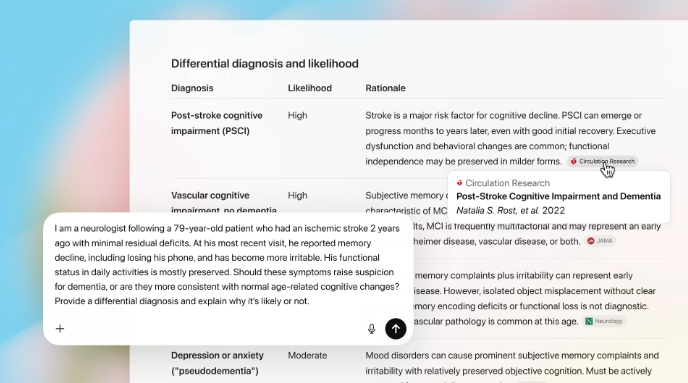
The new platform includes ChatGPT for Healthcare and expanded API tools designed for use across clinical, administrative, and research workflows.
OpenAI has introduced OpenAI for Healthcare, a new suite of enterprise artificial intelligence (AI) products aimed at helping healthcare organizations scale clinical and administrative workflows while supporting HIPAA compliance, according to a company announcement released January 8.
The launch includes ChatGPT for Healthcare, which is available immediately, as well as expanded healthcare use of the OpenAI API. OpenAI says the offering is designed to give hospitals and health systems a secure, enterprise-grade foundation for deploying AI across clinical, research, and operational teams.
Early adopters named by the company include AdventHealth, Baylor Scott & White Health, Boston Children’s Hospital, Cedars-Sinai Medical Center, HCA Healthcare, Memorial Sloan Kettering Cancer Center, Stanford Medicine Children’s Health, and University of California, San Francisco.
Focus on Regulated Healthcare Environments
OpenAI positioned the announcement around growing clinician workload and fragmented medical information, noting that many clinicians already use AI tools independently because enterprise adoption has lagged in regulated healthcare environments.
“OpenAI for Healthcare helps close that gap by giving organizations a secure, enterprise-grade foundation for AI—so teams can use the same tools to deliver better, more reliable care, while supporting HIPAA compliance,” reads a release from the company.
ChatGPT for Healthcare Capabilities
According to OpenAI, ChatGPT for Healthcare is designed to support evidence-based clinical reasoning while reducing administrative burden. The product brings clinicians, administrators, and researchers into a centralized workspace with governance and access controls.
Key features outlined in the announcement include:
- Healthcare-optimized models: Responses are powered by GPT-5 models developed for healthcare workflows and evaluated through physician-led testing using benchmarks such as HealthBench and GDPval.
- Evidence-based answers with citations: The system retrieves information from peer-reviewed research, clinical guidelines, and public health sources, providing transparent citations with publication details.
- Institutional alignment: Integrations with enterprise platforms, including Microsoft SharePoint, allow responses to reflect organization-specific policies, care pathways, and operational guidance.
- Workflow automation: Reusable templates support tasks such as discharge summaries, patient instructions, clinical correspondence, and prior authorization documentation.
- Access management and governance: Role-based access controls, SAML single sign-on, and SCIM-based user management are included to support enterprise-scale deployment.
- Data control and HIPAA support: OpenAI said patient data remains under customer control, with options for audit logs, data residency, customer-managed encryption keys, and business associate agreements. Content shared with ChatGPT for Healthcare is not used to train models, according to the company.
In practice, OpenAI says healthcare teams are using the platform to synthesize medical evidence alongside internal guidance, draft clinical and administrative documentation, and adapt patient-facing materials for readability and translation.
Early Hospital Feedback
Boston Children’s Hospital is among the early users. In the announcement, John Brownstein, senior vice president and chief innovation officer at the hospital, says early work with a custom OpenAI-powered solution helped the organization establish governance and demonstrate value.
“ChatGPT for Healthcare offers a path toward operational scale, providing an enterprise-grade platform that can support broad, responsible adoption across clinical, research, and administrative teams,” Brownstein says in the statement.
OpenAI API for Healthcare
In addition to ChatGPT for Healthcare, OpenAI highlighted continued expansion of its API platform for healthcare developers. The company says eligible customers can apply for business associate agreements to support HIPAA-compliant use of the API.
Organizations are using the API to build tools for patient chart summarization, care team coordination, and discharge workflows, according to OpenAI. The company cites healthcare technology vendors such as Abridge, Ambience, and EliseAI as examples of companies building ambient documentation, scheduling, and automation capabilities using OpenAI models.
Model Development and Evaluation
OpenAI notes in a release that all OpenAI for Healthcare products are powered by GPT-5.2 models, which have been evaluated through partnerships with more than 260 licensed physicians across 60 countries. According to the company, physicians have reviewed more than 600,000 model outputs across 30 clinical focus areas, informing model training, safety mitigations, and product design.
The company also references evidence from live deployments, including a study with Penda Health that found an OpenAI-powered clinical copilot reduced diagnostic and treatment errors in routine primary care settings.
Benchmarks such as HealthBench, an open clinician-designed evaluation framework, were cited as showing improved performance in clinical reasoning, safety, and communication compared with earlier model generations.
Broader Healthcare Strategy
OpenAI says the launch builds on its broader healthcare and life sciences work, including consumer-facing health tools, biopharma research collaborations, and partnerships with life sciences companies such as Amgen, Thermo Fisher, and Moderna. The company also works with consulting firms including Boston Consulting Group, Bain, McKinsey & Company, and Accenture to support healthcare AI adoption.
OpenAI plans to continue working with healthcare organizations using OpenAI for Healthcare to refine the platform based on real-world use.
Photo caption: ChatGPT for Healthcare
Photo credit: OpenAI


I’ll put it as simply as I can:
How is Verification and Validation performed for AI-based medical devices?
To perform verification, a specification for the device under consideration must be available. How do you write a specification for a device that can essentially modify itself?
To perform validation, the user requirements must be available (not to mention the user) that were used to develop the specificaiton.How do you do that in this new world?
How does AI fit under the prevailing regulatory environment? I believe MDA 1976 has not been replaced with new regs. What is the predicate device for ANY AI-device? What is the meaning of “substantially equivalent” anymore?
Or am I wrong? Have new regulations been established and promulgated?