
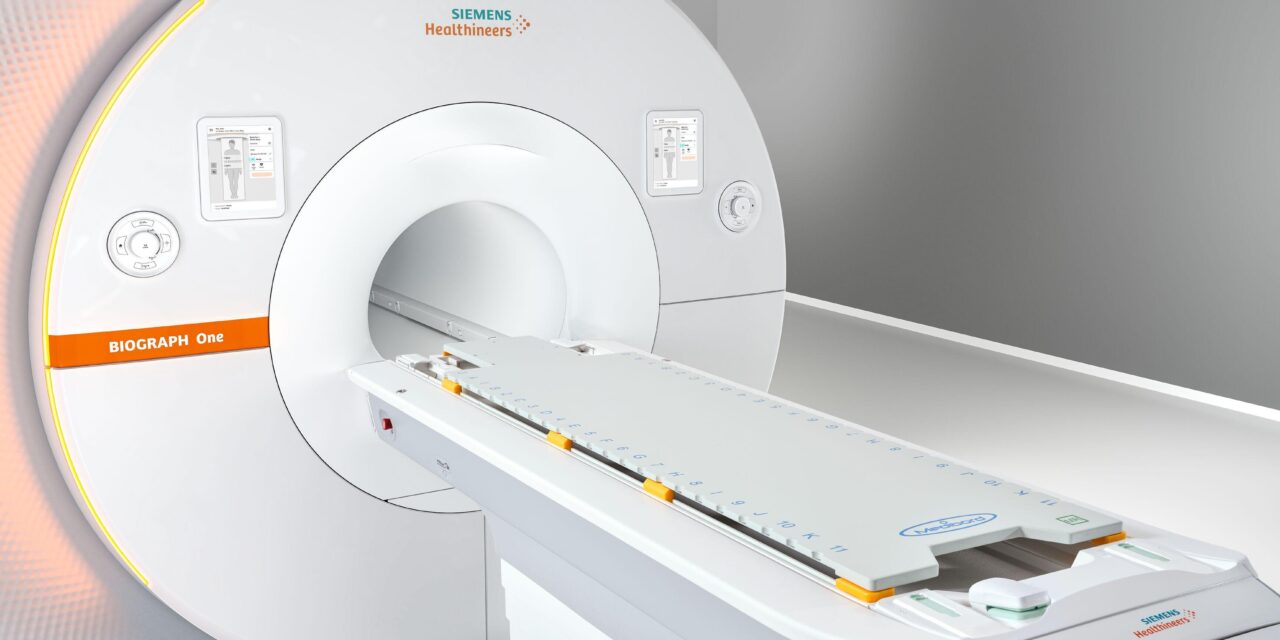
The second-generation system combines anatomical and functional imaging in one scan.
The US Food and Drug Administration (FDA) has cleared Siemens Healthineers’ Biograph One, a second-generation positron emission tomography/magnetic resonance (PET/MR) scanner designed to enable simultaneous visualization of organ location, function, and cellular metabolism.
Siemens Healthineers introduced its first PET/MR system in 2011 with the Biograph mMR. Benefiting from customer feedback, the second-generation Biograph One integrates PET and MR to reduce operational complications associated with other PET/MR scanners. The new system has features for faster acquisition times and more efficient workflows, and can reduce patient scan times by 50% percent, compared to Biograph mMR.
Its MR technology is based on the Magnetom Vida 3 Tesla scanner, and its digital PET detector with lutetium oxyorthosilicate crystals is founded on the Biograph Vision PET/CT scanner. The PET/CT technology generates images with high spatial resolution and a time-of-flight of 187 picoseconds. According to a release from the company, this level of spatial resolution and time-of-flight could increase system sensitivity for faster examinations and flexible dose administration.
“Patients experience a long, arduous pathway to answers and treatment. The Biograph One is the culmination of over a decade of experience in harnessing the diagnostic power of these two imaging worlds into one single modality, resulting in one truly patient-centric pathway for every single patient,” says Katie Grant, head of magnetic resonance at Siemens Healthineers North America, in a release.
Many PET/MR scans are whole-body exams, which often exceed 60 minutes. With a 35 cm axial FOV digital PET detector the Biograph One is ideal for scanning large body regions. A large PET detector reduces acquisition time for whole-body images by requiring fewer bed positions, bringing scan times to less than 30 minutes to fit more typical radiology schedules and support twice as many patients.
Several AI technologies are embedded within the Biograph One. New to PET/MR, the MyExam Companion user interface provides radiologic technologists with automation features to simplify the scanning workflow. Deep Resolve Boost 2D and 3D image reconstruction technology accelerates image acquisition while removing noise and improving image sharpness. New, flexible BioMatrix Contour XL MR coils resemble blankets and provide whole-body patient coverage using fewer coils, reducing setup time and technologist exposure to radiation, according to the company. An integrated BioMatrix Position Sensor communicates with the system to suggest optimal patient positioning, potentially reducing exam setup time.
Photo caption: Biograph One
Photo credit: Siemens Healthineers