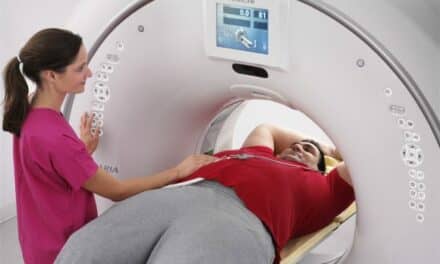
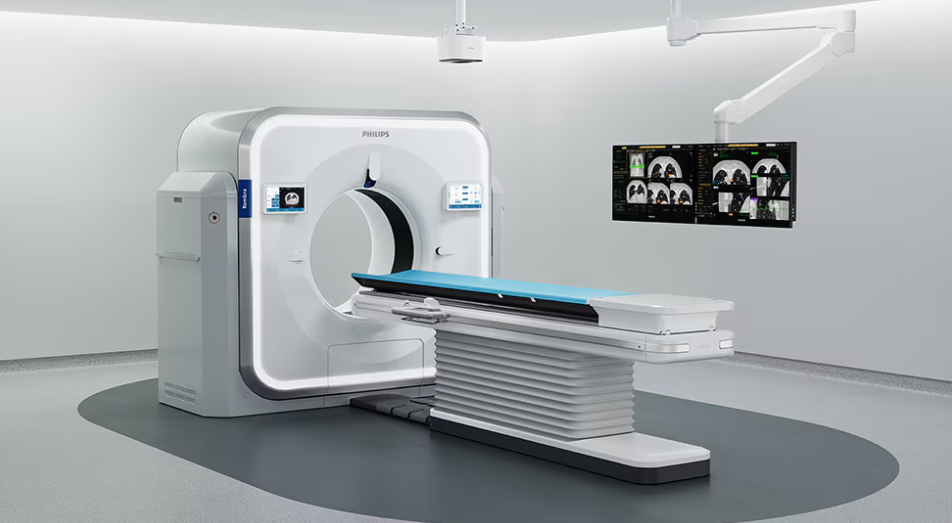
The new CT platform features fast reconstruction speeds, an 85-cm bore, and AI-enabled workflows aimed at improving throughput.
Royal Philips introduced Rembra, a next-generation computed tomography system designed for acute and high-demand imaging environments. The system was showcased at the European Congress of Radiology (ECR) 2026 in Vienna.
Rembra delivers reconstruction speeds of up to 106 images per second and can support up to 270 patients per day, according to the company. The system is CE marked with Food and Drug Administration (FDA) 510(k) clearance pending.
“Rembra is built for the realities that clinicians face every day,” says Dan Xu, business leader for computed tomography at Philips, in a release. “By combining our most advanced detector technology with AI-powered workflows and industry-leading speed, Rembra represents a significant step forward for high-acuity imaging, delivering speed, access, and diagnostic confidence when it matters most.”
Large Bore Design for Complex Cases
The system features an 85 cm bore, which Philips describes as the largest in its class. This design accommodates challenging patient types and provides access for complex interventions, bariatric imaging, and trauma cases, potentially reducing the need for rescans, according to the company.
Rembra includes a 60 cm standard field of view and an 85 cm extended field of view, both described as the largest in their class of frontline radiology CT systems. The system also features a patient table with a scan range of up to 2.3 meters and gantry-to-tablespace of 46 cm.
“In interventional and high acuity settings, precise access and efficient positioning are essential,” says Professor Olivier Rouvière, MD, PhD, head of department at Hospices Civils de Lyon (Centre Hospitalier Universitaire de Lyon), in a release. “Rembra’s 85 cm bore supports improved access as well as faster and safer positioning of long needles and instruments in complex procedures.”
Advanced Detector Technology
The system incorporates Philips’ NanoPanel Precise XD detector, designed to work with AI for dose-efficient, high-resolution imaging. The detector offers in-plane spatial resolution of 23 line pairs per cm, enabling visualization of anatomical structures down to 0.25 mm, according to the company.
A 2D anti-scatter grid provides scatter rejection to help preserve image clarity across different patient sizes and clinical scenarios, Philips says.
The system includes AI-enabled workflows designed to automate routine steps and simplify operations. Rembra is built for operations at high-altitude environments up to 5,000 meters and is engineered for a system lifetime of up to 20 years with required maintenance and upgrades.
Philips also introduced its Tube for Life service program, which covers tube replacement costs for up to 10 years.
Spectral CT System Also Debuts
At ECR 2026, Philips also showcased Verida, described as the world’s first detector-based spectral CT powered by AI. The system, first introduced at the Radiological Society of North America meeting in 2025, integrates AI across the imaging chain and is designed to deliver spectral image quality while helping to accelerate workflows and reduce dose.
Photo caption: Rembra
Photo credit: Philips