
New data from a 15,000-patient registry and a comparative effectiveness study show AI-based plaque analysis may outperform conventional cardiac testing in identifying high-risk patients and guiding preventive treatment.
Heartflow Inc announced new clinical evidence and a registry launch aimed at advancing the management of coronary artery disease across the full patient care continuum, with data being presented at the American College of Cardiology (ACC) Annual Scientific Session.
The announcements center on two areas: new real-world data supporting Heartflow Plaque Analysis as an independent risk stratification tool, and the first patient enrollment in the NAVIGATE-PCI Registry, a large-scale study evaluating artificial intelligence (AI)-guided planning for percutaneous coronary intervention (PCI) procedures.
Long-Term Registry Data Links Plaque Volume to Adverse Events
The most expansive dataset being presented at ACC 2026 comes from the Mass General Brigham Coronary Computed Tomographic Angiography (CCTA) Registry, which tracked more than 15,000 patients over up to 16 years. The study found that Heartflow Plaque Analysis independently predicted major adverse cardiovascular events (MACE), even after accounting for traditional risk factors and the degree of coronary stenosis. Patients with extensive plaque volume faced a fourfold higher risk of MACE, according to the company.
“Stenosis has long been our primary lens for evaluating coronary risk, but it tells an incomplete story, as this registry demonstrates,” says Ron Blankstein, MD, director of cardiac computed tomography at Brigham and Women’s Hospital and professor of medicine and radiology at Harvard Medical School, in a release. “With over 15,000 patients and 16 years of follow-up, we now have compelling real-world evidence that total plaque volume independently drives adverse events, regardless of risk factors or the presence of anatomical stenosis.”
The findings are being presented as Poster 1082-09 on March 29.
Plaque Analysis Linked to Better Lipid Management Outcomes
A second presentation draws from the DECIDE Registry, which enrolled nearly 3,800 patients and compared care guided by CCTA with Plaque Analysis versus traditional stress-test-guided care over one year. Patients whose management incorporated Plaque Analysis were more likely to initiate lipid-lowering therapy and achieve guideline-recommended low-density lipoprotein (LDL) goals of less than 70 mg/dL, according to the company.
Primary endpoint data from the DECIDE Registry—described by Heartflow as the largest prospective registry evaluating the clinical impact of Plaque Analysis on medical management decisions—were recently published in JACC Cardiovascular Imaging. The presentation is scheduled as Poster 1469-058 on March 29.
Budget Analysis Shows Cost Parity Within Two Years
A third presentation addresses the economic case for AI-guided plaque analysis from the perspective of US payers. The analysis found that cost-effectiveness and parity with usual care are achieved in under two years, with total population savings of $140 million, according to the company. The incremental testing costs required to prevent a single MACE event fall significantly below the actual cost of treating one, the analysis found. That poster (1468-019) is also scheduled for March 29.
“These findings catalyze a meaningful shift in how we approach risk stratification by more accurately identifying patients who might otherwise have been characterized as having lower risk based on conventional assessment and optimizing management based on their actual disease burden,” Blankstein says in a release.
NAVIGATE-PCI Registry Launches to Evaluate CT-Guided Intervention Planning
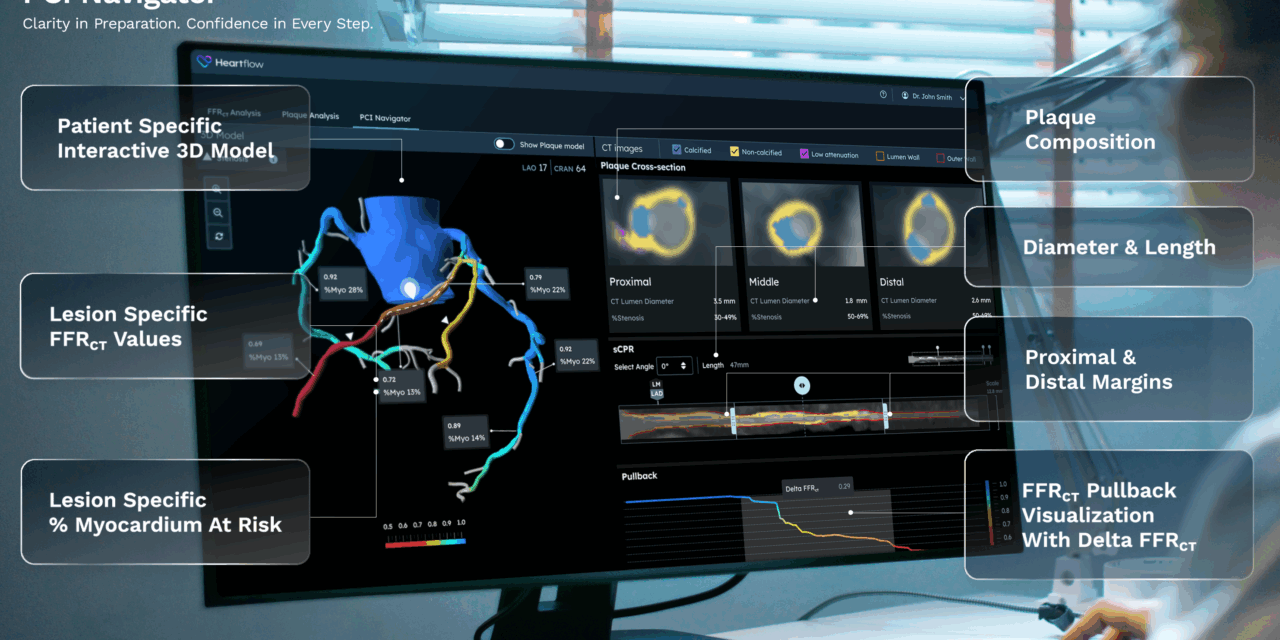
In parallel with the ACC presentations, Heartflow announced that the first patient has been enrolled in the NAVIGATE-PCI Registry, which will evaluate how CT-guided PCI planning using the company’s PCI Navigator platform affects clinical strategy, procedural efficiency, and physician confidence in the cardiac catheterization lab.
The registry is described as the first large-scale effort to assess the clinical implications of CT-guided PCI planning. Investigators will examine whether pre-procedural insights from AI-driven coronary anatomy, physiology, and plaque data alter treatment decisions compared to angiography alone.
“AI-powered technology is rapidly evolving, now offering interventional cardiologists the opportunity to start planning percutaneous coronary interventions before we enter the cath lab, from any computer, anywhere,” says Ziad Ali, MD, DPhil, director of the DeMatteis Cardiovascular Institute at St. Francis Hospital & Heart Center and co-principal investigator of the NAVIGATE-PCI Study, in a release. “CT-guided PCI planning allows us to anticipate lesion complexity, select devices more intelligently, and enter the cath lab with a clear procedural strategy.”
Todd Villines, MD, FACC, professor of medicine in the division of cardiology at the University of Virginia and co-principal investigator of the study, emphasized the registry’s role in generating the evidence needed for broader clinical adoption. “NAVIGATE-PCI will generate evidence on how pre-procedural insights influence concrete decisions across procedural planning, lesion preparation strategy and expected stent placement,” Villines says in a release. “This level of clinical clarity is what physicians and health systems need to confidently integrate this innovative capability into everyday practice.”
Heartflow PCI Navigator is described by the company as the only integrated, AI-driven PCI planning tool that provides interventional cardiologists with a patient-specific three-dimensional model of coronary anatomy, plaque composition, and lesion-specific physiology. Commercial availability of PCI Navigator is expected in the second quarter of 2026.
About Heartflow Plaque Analysis
Heartflow Plaque Analysis is Food and Drug Administration-cleared and is described by the company as the only AI-powered plaque analysis tool with a reported 95% agreement with intravascular ultrasound—considered the gold standard—in a prospective, international trial using blinded core lab adjudication. Heartflow reports the technology has been adopted by more than 1,400 institutions globally and that its AI-driven solutions have been evaluated in over 200 studies assessing more than 365,000 patients.
Photo caption: Heartflow PCI Navigator
Photo credit: Heartflow