The low-profile overlay is designed for use during extended surgeries to reduce the risk of hospital-acquired pressure injuries.
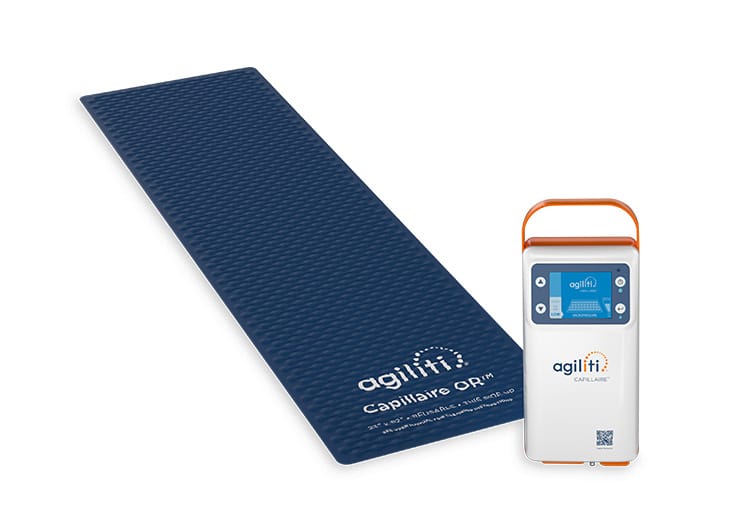
Agiliti has launched Capillaire, a low-profile alternating air pressure support surface designed to prevent and treat perioperative pressure injuries during surgeries lasting longer than two hours, according to a company release. The overlay provides dynamic pressure redistribution and is compatible with most operating room (OR) tables and stretcher platforms across surgical, perioperative, and emergency care environments.
“Pressure injuries remain a significant challenge for healthcare providers, particularly during extended surgeries or prolonged emergency department stays,” says Tim McCarty, general manager of beds and therapeutic surfaces at Agiliti, in a release. “Capillaire is the industry’s only low-profile alternating air pressure support surface, designed to deliver continuous micro-offloading and enhanced skin perfusion for patients where repositioning is limited or not possible—helping to significantly reduce the risk of hospital-acquired pressure injuries.”
Addressing Surgical Risk Factors
According to guidelines from the Association of Perioperative Registered Nurses cited by Agiliti, time in the OR beyond two hours is an intrinsic risk factor for perioperative pressure injury. The guidelines suggest that patients at high risk should be placed on an alternating air pressure support surface.
Data cited by the company indicates that 23% of hospital-acquired pressure injuries (HAPI) occur intraoperatively during surgeries lasting more than three hours. Furthermore, pressure injury risk increases approximately 33% for every 30 minutes beyond four hours in the OR.
The Capillaire system is designed to help care teams reduce these risks through improved perfusion and micro-offloading. Key features of the technology include:
- A geometric series of air-filled nodes that alternate inflation and deflation in five-minute cycles.
- A low profile of less than one inch to maintain procedural positioning.
- Compatibility with various surface sizes, including pediatric, stretcher, and multiple OR table configurations.
- A compact controller with a 15-foot latching power cord for flexible setups.
Clinical studies have evaluated the effectiveness of the alternating pressure overlay in high-risk surgical populations. According to the company, research has shown the technology can help decrease OR-related HAPI rates from 11% to 0% in cardiovascular patients and perioperative pressure injuries from 6% to 0% in neurosurgical patients.